Property Management Has a Wellbeing Problem. But Are We Addressing the Right Causes?
Property Management Has a Wellbeing Problem. But Are We Addressing the Right Causes?
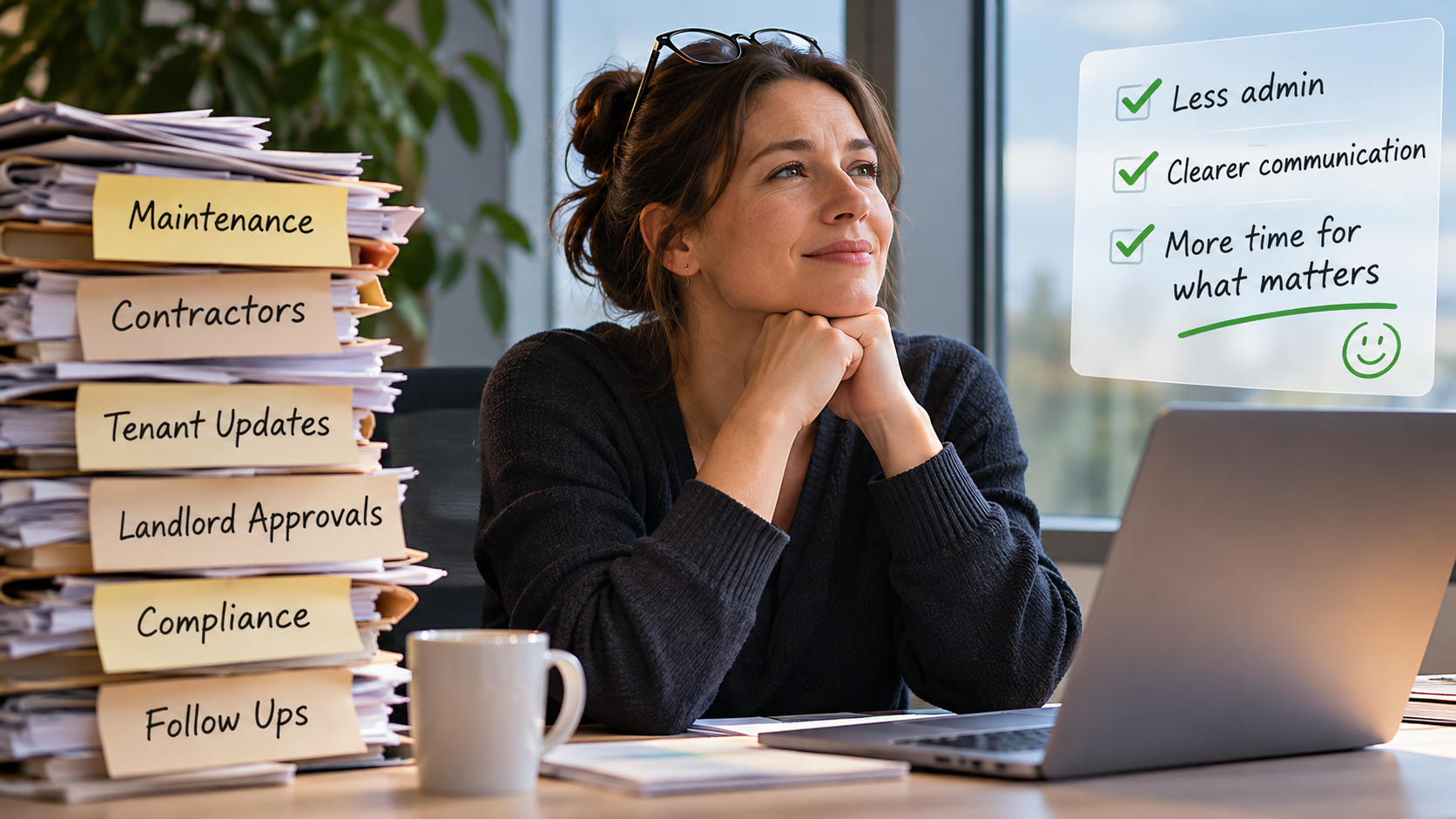
The latest industry wellbeing figures make uncomfortable reading. But beyond the statistics lies a question worth asking: how much of the pressure on property managers comes from the work itself, and how much comes from the way that work is organised?
Property management has never been an easy profession.
It requires patience, organisation, problem-solving, technical knowledge and the ability to manage competing expectations, often simultaneously.
A tenant needs an urgent repair. A landlord wants an update. A contractor hasn't responded. A compliance deadline is approaching.
And somewhere in the middle is the property manager, trying to keep everything moving.
That's always been part of the job.
But increasingly, it seems that simply managing the work is becoming as demanding as the work itself.
The numbers should concern everyone
The Property Institute's 2026 Wellbeing & Resilience Survey paints a troubling picture of the pressures facing residential property management professionals.
Among the 483 respondents:
89% reported experiencing some form of abuse during the previous 12 months.
63% believed their mental health was at risk because of work.
45% were either planning to leave the profession or unsure whether they would stay.
These figures deserve attention.
They also deserve more than another conversation about resilience.
Because while supporting individuals is essential, we should also be examining the working environments and processes that contribute to these pressures.
The hidden workload nobody really measures
Consider a fairly ordinary maintenance issue.
A tenant reports a leaking tap.
The initial message doesn't contain enough information, so the property manager asks for photographs.
The tenant replies the following morning.
The property manager contacts a contractor, who asks for the property's address and the tenant's availability.
Another email goes to the tenant.
The contractor provides a quote.
The landlord needs to approve it.
The property manager follows up.
Eventually, the repair is scheduled.
Then the tenant calls asking what's happening.
None of this is particularly unusual.
But look at how much of the property manager's time has been spent moving information between people.
The actual maintenance issue hasn't changed.
What has grown is the administrative workload surrounding it.
And when this happens across dozens or hundreds of properties, the cumulative effect can be substantial.
The problem isn't always the number of maintenance issues. Sometimes it's the number of times each issue has to be handled.
When communication becomes another job
Communication is fundamental to good property management.
Tenants need reassurance. Landlords need visibility. Contractors need clear instructions.
But communication becomes inefficient when information is scattered across multiple channels.
An email contains the original report.
A WhatsApp message contains the photographs.
A telephone conversation confirms the appointment.
The contractor sends an update by text.
The landlord's approval sits somewhere in an inbox.
Individually, these are small interactions.
Collectively, they create a fragmented record that someone has to maintain.
And that someone is usually the property manager.
This creates another challenge.
When a colleague is absent, changes role or leaves the organisation, much of the knowledge surrounding ongoing maintenance can be difficult to reconstruct.
The information may exist, but finding it takes time.
In some cases, the same questions have to be asked again.
The same details have to be entered again.
And the same conversations have to happen again.
That's not necessarily a people problem.
It's often a process problem.
The cost of being the person who knows everything
Experienced property managers develop an extraordinary amount of knowledge.
They remember which contractor attended a particular property.
They know which landlord prefers a telephone call.
They remember the tenant who can only provide access on Tuesdays.
They know which repairs have been delayed and why.
That experience is incredibly valuable.
But it can also create an unhealthy dependency.
When the smooth running of a portfolio relies on one person remembering everything, the organisation becomes vulnerable.
That person struggles to switch off.
Taking annual leave can mean returning to a mountain of unanswered questions.
And when colleagues need information, they know exactly whom to ask.
The most capable people can end up carrying the greatest burden.
Good systems should preserve their knowledge, not depend on their constant availability.
Wellbeing needs more than good intentions
There is encouraging evidence that organisational support makes a difference.
The Property Institute's 2026 survey found that respondents who reported genuine employer action on wellbeing had substantially higher wellbeing scores than those who reported no meaningful action.
That's important.
It suggests that what organisations actually do matters.
Supportive management, reasonable expectations, clear boundaries and protection from abusive behaviour are all essential.
But there is another part of the conversation.
Are we making the work itself easier to manage?
If a property manager spends a significant proportion of the day chasing information, duplicating records and manually updating multiple people, simply encouraging them to take breaks won't address the underlying problem.
A wellbeing strategy should consider the operational environment as well as the individual.
That means examining where unnecessary work is being created and finding practical ways to remove it.
What would a better working day look like?
Imagine the same maintenance issue being handled differently.
The tenant reports the problem through a property-specific QR code.
The property is identified automatically.
Relevant questions are asked at the point of reporting, and photographs and availability are collected before the issue reaches the property manager.
The information is organised into a structured report.
The contractor receives the details needed to assess the job.
The landlord can review the relevant information.
Updates are recorded in a shared timeline, with everyone able to see the progress relevant to them.
The property manager remains in control of the process.
But instead of spending the day collecting, repeating and reconstructing information, they can focus on decisions, exceptions and the issues that genuinely require their expertise.
This is the kind of operational improvement that deserves a place in conversations about wellbeing.
Not because technology can solve every problem.
It can't.
But because reducing unnecessary administration can create more time and space for the work that matters.
Technology should reduce work, not rearrange it
Of course, introducing technology isn't automatically the answer.
A new platform that creates another inbox, another set of records or another place to check can simply move the problem elsewhere.
Property managers don't need more systems to manage.
They need better-connected processes.
The real test of any operational change should be straightforward:
Does it reduce the number of times information needs to be entered?
Does it eliminate unnecessary chasing?
Does it make responsibilities clearer?
Can someone else understand the status of a job without asking the person who originally handled it?
And perhaps most importantly, does it give property managers more time to do the parts of their jobs that actually require their experience and judgement?
If the answer is no, it's worth questioning whether the change represents genuine progress.
We shouldn't forget what people enjoy about the profession
There's a risk that conversations about property management wellbeing become entirely negative.
And that would be a shame.
Because there are plenty of reasons people enjoy this profession.
Solving a difficult problem.
Helping a tenant.
Building trusted relationships.
Working with good colleagues.
The satisfaction of finally getting a complicated issue resolved.
These are meaningful parts of the job.
The challenge is ensuring they aren't buried beneath layers of unnecessary administration.
Property management will always involve difficult situations and competing demands.
But it shouldn't require people to spend so much of their time searching for information, repeating conversations or compensating for fragmented processes.
A different question for the industry
The Property Institute's findings should encourage serious reflection across the sector.
Not every pressure can be solved through better processes. Abuse, unrealistic expectations, inadequate staffing and poor management require direct action.
But operational inefficiency is one area where organisations can make tangible improvements.
And those improvements may benefit more than productivity.
They can help create a working environment where people feel more in control, better supported and less dependent on constantly keeping everything in their heads.
Perhaps the question isn't simply:
How do we help property managers cope with the workload?
Perhaps we should also be asking:
How much of that workload should exist in the first place?
Because the future of property management shouldn't depend on people becoming endlessly more resilient.
It should involve building working environments that place fewer unnecessary demands on them.
And that seems like a much better place to start.
Stephen Marr is Co-Founder and Commercial Director of Nestsen, a maintenance, communication and audit trail platform designed to reduce administrative friction and improve visibility throughout the property maintenance process.
Source: The Property Institute, 2026 Wellbeing & Resilience Survey Report.
Share this article
See Nestsen in action
Join property managers across the UK who have cut response times, reduced compliance risk and kept tenants happier with Nestsen.
Book a free demo →You might also like
If the Landlord Can't See the Work, Did It Happen?
14 October 2026
The Hidden Mental Load of Property Management: Why Unfinished Work Follows People Home
13 October 2026

Have We Digitised Property Management Without Making It Easier?
3 October 2026

Your Best Property Manager Shouldn't Be Your Operating System
1 October 2026