The Hidden Mental Load of Property Management: Why Unfinished Work Follows People Home
The Hidden Mental Load of Property Management: Why Unfinished Work Follows People Home
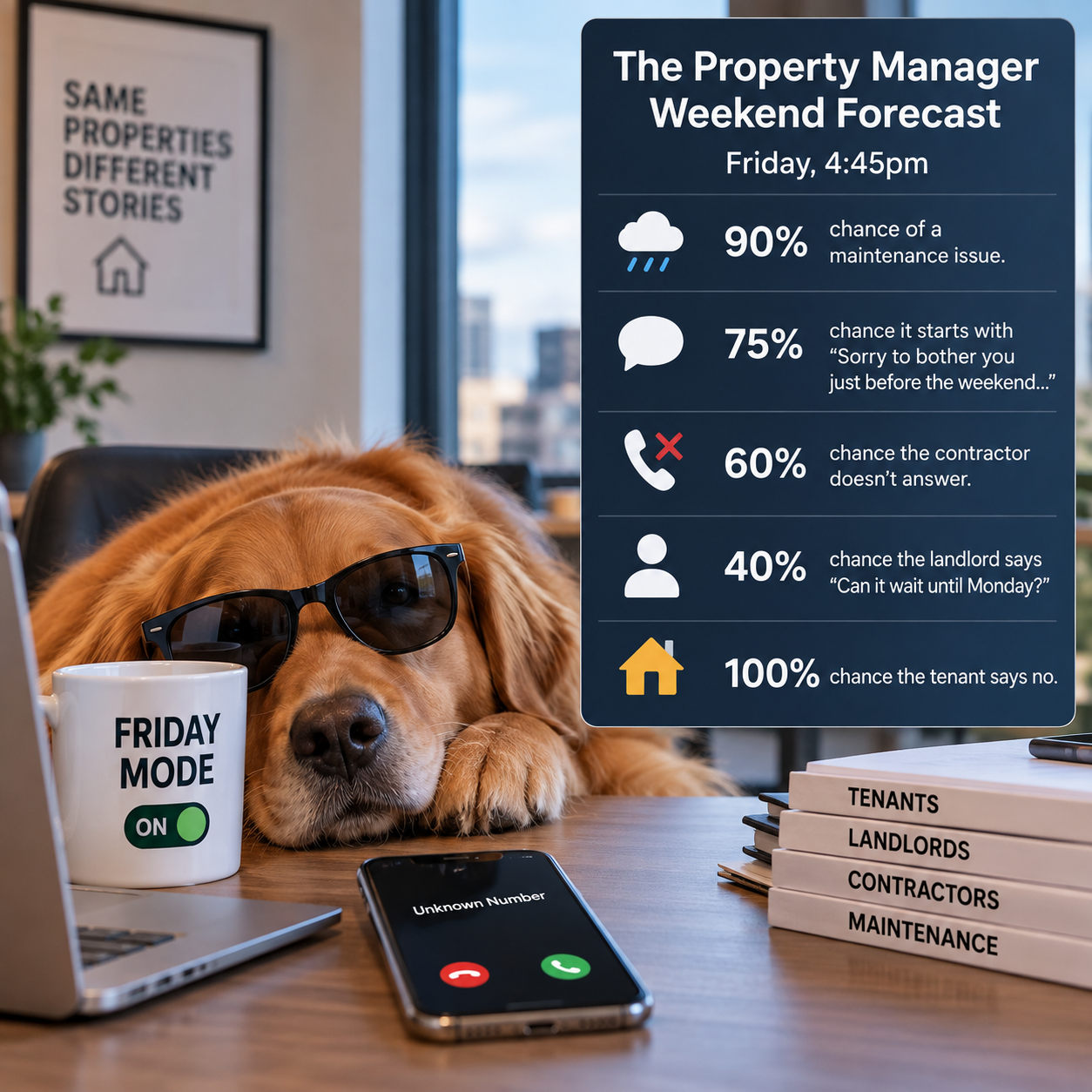
The working day ends. The responsibility doesn't always end with it.
It's 7:30 on a Tuesday evening.
A property manager is sitting at home, perhaps watching television, having dinner or spending time with family.
Then something crosses their mind.
Did that contractor ever confirm Thursday?
They remember the landlord who still hasn't approved a quote.
The tenant who was promised an update.
The repair that was reported on Friday but hasn't progressed.
The email they meant to send before leaving.
None of these things is necessarily an emergency.
But none of them feels quite finished either.
And that's the problem.
Property management doesn't just create tasks. It creates unfinished responsibilities that people carry around in their heads.
The work nobody sees
When we talk about the pressures of property management, we tend to focus on the visible workload.
The number of properties managed.
The volume of maintenance requests.
The phone calls, emails and inspections.
The contractors to organise and the landlords to update.
All legitimate measures of how busy a property manager might be.
But there's another workload that's much harder to measure.
The mental effort involved in remembering what hasn't happened yet.
A contractor is supposed to call back.
A landlord needs to make a decision.
A tenant is expecting an update.
A colleague has promised to investigate something.
A quote has been requested, but nobody has confirmed when it will arrive.
Individually, these might seem like small things.
Collectively, they create a remarkable amount of mental clutter.
Because somebody has to remember them.
And in many agencies, that somebody is the property manager.
The problem with open loops
Think about a typical maintenance request.
A tenant reports a leaking tap.
The property manager contacts a contractor.
The contractor promises to visit.
The landlord wants a quote before approving the work.
The tenant asks when somebody is coming.
The contractor hasn't replied.
The landlord is now chasing.
At any given moment, the property manager may not actually have anything they can do to move the repair forward.
They're waiting.
But waiting doesn't mean the responsibility disappears.
They still need to remember who they're waiting for, what was promised, when to follow up and who needs to be informed.
That's an open loop.
And one maintenance issue can create several of them.
Now multiply that across dozens or hundreds of properties.
The problem isn't simply the number of jobs. It's the number of unfinished conversations attached to those jobs.
Why unfinished work stays with us
There's a psychological explanation for why these outstanding tasks can be so difficult to put aside.
It's often discussed in relation to the Zeigarnik effect, the idea that unfinished tasks can remain particularly prominent in our thoughts.
Research into occupational stress has also found an association between unfinished work and thinking about work during personal time.
The important distinction is that the brain isn't necessarily asking us to complete every task immediately.
Often, it's looking for reassurance that something hasn't been forgotten.
That there's a plan.
That somebody owns the next action.
That the responsibility hasn't disappeared into an inbox.
But when information is scattered across emails, WhatsApp messages, phone calls, spreadsheets and different systems, that reassurance can be difficult to find.
So people compensate.
They remember.
They make mental notes.
They check their phones.
They run through tomorrow's priorities while trying to switch off.
The property manager becomes the system that holds everything together.
And that is an exhausting position to be in.
Being responsible isn't the same as being able to act
One of the most frustrating aspects of property management is how much time is spent waiting for other people.
Waiting for a contractor.
Waiting for a landlord.
Waiting for a tenant.
Waiting for a quote.
Waiting for access.
Waiting for somebody to answer a question.
The property manager may have done everything required of them.
Yet the issue remains unresolved.
And because they're the person coordinating the process, they're often the one who gets chased.
This creates an uncomfortable imbalance.
They're accountable for progress they don't always control.
A landlord understandably wants to know what's happening.
A tenant understandably wants their repair completed.
A contractor may be juggling several jobs.
The property manager sits in the middle, expected to keep everybody informed.
And even when they're not actively working on an issue, they're often mentally managing it.
The hidden cost of being the person who remembers everything
Experienced property managers are remarkably good at holding complicated situations together.
They remember which landlords prefer a phone call.
Which contractors are reliable.
Which tenants need extra reassurance.
Which repairs have become sensitive.
Which promises were made last Thursday.
That experience is enormously valuable.
But there's a danger when the smooth running of an operation depends too heavily on what one individual remembers.
What happens when that person is on holiday?
Or off sick?
Or simply trying to finish work on time?
Suddenly, colleagues need to reconstruct conversations.
Search through emails.
Find WhatsApp messages.
Work out who last spoke to the contractor.
And establish what the tenant has already been told.
The information probably exists somewhere.
But it isn't necessarily visible to the people who need it.
This is where an operational problem becomes a human one.
Because when people know that everything depends on them, switching off becomes much harder.
They might leave the office.
But mentally, they're still at work.
More software isn't necessarily the answer
It's tempting to assume that every operational challenge can be solved by introducing another system.
But property managers already work with plenty of technology.
CRM platforms.
Email.
WhatsApp.
Contractor portals.
Spreadsheets.
Task lists.
The issue isn't always a lack of tools.
Sometimes it's that the tools create more places to check.
Another notification.
Another update.
Another system that needs maintaining.
And another responsibility for the property manager.
Technology only reduces mental workload when it removes something people would otherwise have to remember, chase or reconstruct.
A system that simply records more work isn't necessarily making anyone's job easier.
The real question is whether it gives people confidence that nothing important is being overlooked.
What would actually reduce the mental load?
Reducing the mental load of property management doesn't mean removing professional responsibility.
It means making that responsibility easier to manage.
A few principles make a significant difference.
1. Make outstanding work visible
Every open issue should have a clear status.
Not just open or closed, but what is actually happening.
Is the contractor being contacted?
Is a quote outstanding?
Is landlord approval required?
Is the repair scheduled?
When people can see where an issue stands, they don't have to rely on memory.
2. Make ownership clear
Every outstanding action should have an identifiable owner.
If you're waiting for a contractor, that should be visible.
If the landlord needs to approve a quote, that should be clear.
If the next action belongs to the agency, somebody should know who is responsible.
Ambiguity creates unnecessary chasing.
3. Stop making people remember when to chase
If a contractor hasn't responded, the follow-up shouldn't depend entirely on somebody remembering to send another message.
Appropriate reminders and automated follow-ups can remove a surprising amount of routine mental administration.
The judgement remains with the property manager.
The remembering doesn't always have to.
4. Keep the communication together
A maintenance issue shouldn't require somebody to search through three inboxes and a WhatsApp conversation to understand what's happened.
A shared timeline makes it easier to see what was reported, what was promised and what still needs doing.
It also makes handovers far less painful.
5. Make switching off possible
Perhaps the most important outcome isn't faster repairs or fewer emails.
It's the confidence that when somebody finishes work, the outstanding issues are still visible, organised and being managed.
Not forgotten.
Not dependent on one person's memory.
Not waiting silently until somebody remembers to chase.
That confidence matters.
The real measure of operational efficiency
We often measure efficiency in hours saved.
Calls reduced.
Tasks completed.
Repairs resolved.
Those are useful measures.
But perhaps there's another question worth asking.
How much of the working day is your team still carrying around in their heads after they've gone home?
Because an operation can look efficient on paper while quietly depending on individuals to remember hundreds of small details.
And eventually, that comes at a cost.
Not just to productivity.
But to the people doing the work.
At Nestsen, we believe technology should support the judgement and experience of property professionals, not replace it.
That's why our focus is on bringing maintenance communication, coordination and progress into one place, creating a clear record from the initial report through to resolution.
Not simply to make the process more efficient.
But to reduce the need for people to hold the entire process together in their heads.
Because the best property management systems shouldn't just help people manage their workload.
They should help people leave it at work.
Discover Nestsen
See how Nestsen helps letting agents bring maintenance communication, contractor coordination and progress into one place, reducing unnecessary chasing and improving visibility from report to resolution.
Nestsen - Maintenance Operations Software for UK Letting & Managing Agents
Share this article
See Nestsen in action
Join property managers across the UK who have cut response times, reduced compliance risk and kept tenants happier with Nestsen.
Book a free demo →You might also like

Have We Digitised Property Management Without Making It Easier?
3 October 2026

Your Best Property Manager Shouldn't Be Your Operating System
1 October 2026
Why Property Maintenance Is a Landlord Retention Strategy
1 October 2026
If Your Property Manager Has to Remember Who Needs Chasing, the System Isn’t Doing Enough
1 October 2026