Have We Digitised Property Management Without Making It Easier?
Have We Digitised Property Management Without Making It Easier?
Property management has never had more technology.
More platforms.
More portals.
More automation.
More data.
So why are Property Managers still spending so much of their day chasing people?
Chasing contractors for updates.
Chasing landlords for approval.
Chasing tenants for access.
Checking whether somebody replied.
Searching through emails for a conversation from three weeks ago.
Trying to work out what happened, what was agreed and what needs to happen next.
Somewhere along the way, we digitised property management.
But I'm not convinced we always made it easier.
In some cases, we simply digitised the chasing.
Moving work onto a screen isn't the same as removing work
There was a time when digitisation itself represented enormous progress.
Paper files became databases.
Phone messages became emails.
Spreadsheets became property management systems.
Maintenance jobs could be logged electronically rather than written on a piece of paper.
All of that mattered.
But the benchmark has changed.
The question today shouldn't simply be:
“Can our system record this?”
It should be:
“How much work does our system remove from the person managing it?”
Those are very different questions.
A maintenance platform can contain every repair in a portfolio and still leave the Property Manager responsible for remembering who needs chasing.
It can store a contractor's details without doing anything when the contractor doesn't respond.
It can record an update without making sure the people waiting for that update actually receive it.
It can provide a digital record while the real operational work continues through email, WhatsApp, telephone calls and somebody's memory.
Technically, the process has been digitised.
Operationally, very little may have changed.
Property Managers have become the integration layer
This is something I've noticed repeatedly in conversations with people working in property management.
Most teams don't have a shortage of information.
The information exists.
The problem is that it exists in different places.
An issue might begin with a tenant.
The Property Manager records it in one system.
A contractor is contacted by email.
The landlord responds through another channel.
The tenant phones for an update.
A colleague has a separate conversation.
Someone adds a note.
Someone else sends a WhatsApp message.
Every individual action makes sense.
But somebody still has to connect them.
And far too often, that somebody is the Property Manager.
They become the human integration between systems, people and conversations.
The technology stores the pieces.
The Property Manager holds the picture together.
The invisible workload
Consider something as ordinary as a leaking tap.
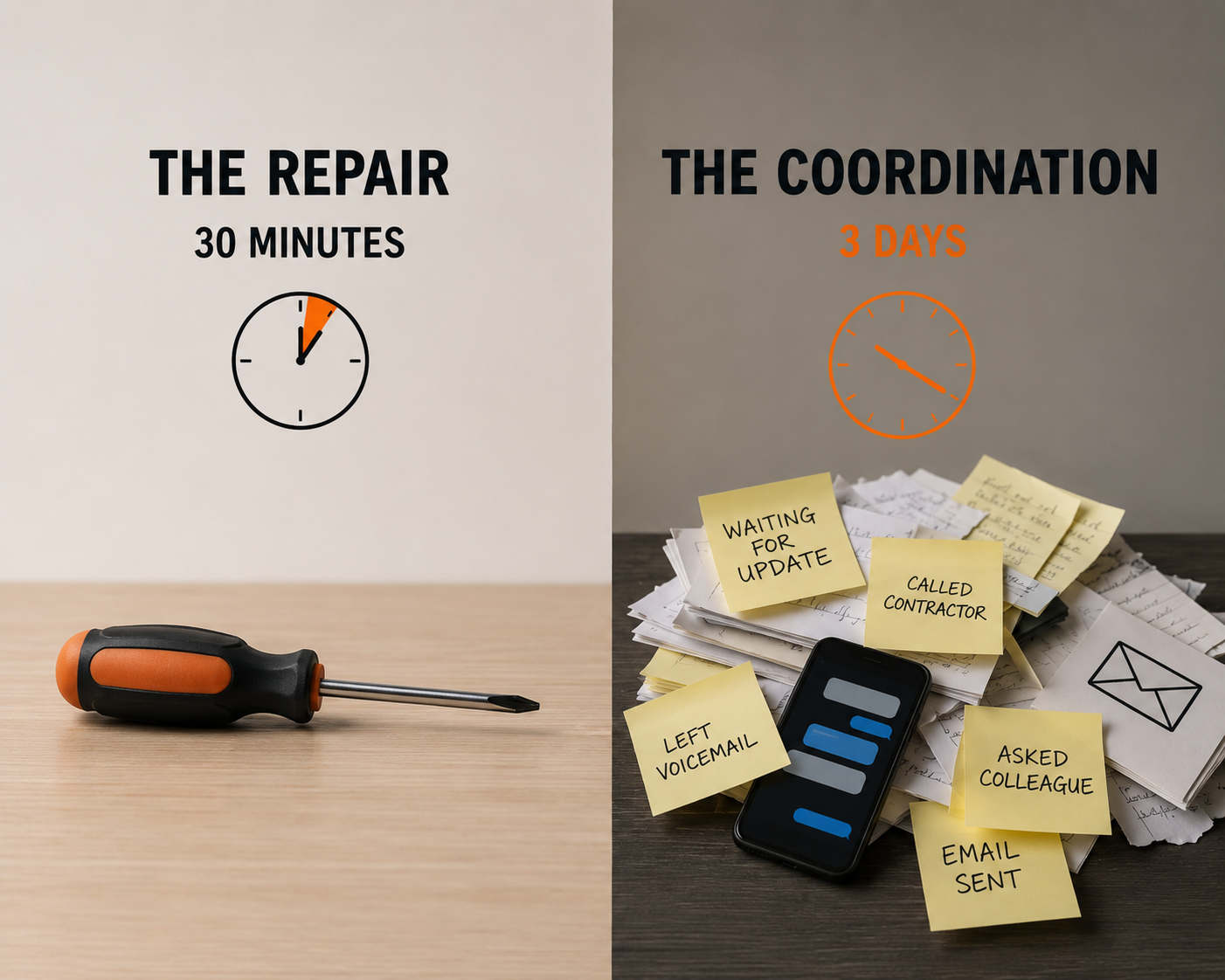
The repair itself might take a contractor 30 minutes.
But managing it can involve:
receiving and understanding the initial report;
asking the tenant for more information;
determining responsibility and urgency;
finding an appropriate contractor;
requesting availability;
obtaining approval;
arranging access;
confirming the appointment;
updating the tenant;
chasing when somebody doesn't respond;
recording what happened;
checking the work was completed;
closing the issue.
None of those tasks is particularly complicated.
That's partly why they're easy to underestimate.
But multiply them across hundreds of properties and dozens of live maintenance issues and the workload becomes enormous.
The Property Manager isn't necessarily spending their day managing difficult repairs.
They're spending it managing everyone else's next move.
We've become very good at recording work
This is where I think property technology needs to evolve.
The first generation of digital property systems answered an important question:
What happened?
They created records.
The next generation needs to answer another:
What needs to happen next — and can the system help make it happen?
That's the difference between recording and orchestration.
If a contractor hasn't responded, why should a Property Manager have to remember to chase them?
If a tenant needs an update, why should somebody have to remember to send it manually?
If important information is missing from a maintenance report, why should the Property Manager always have to start the diagnostic conversation from scratch?
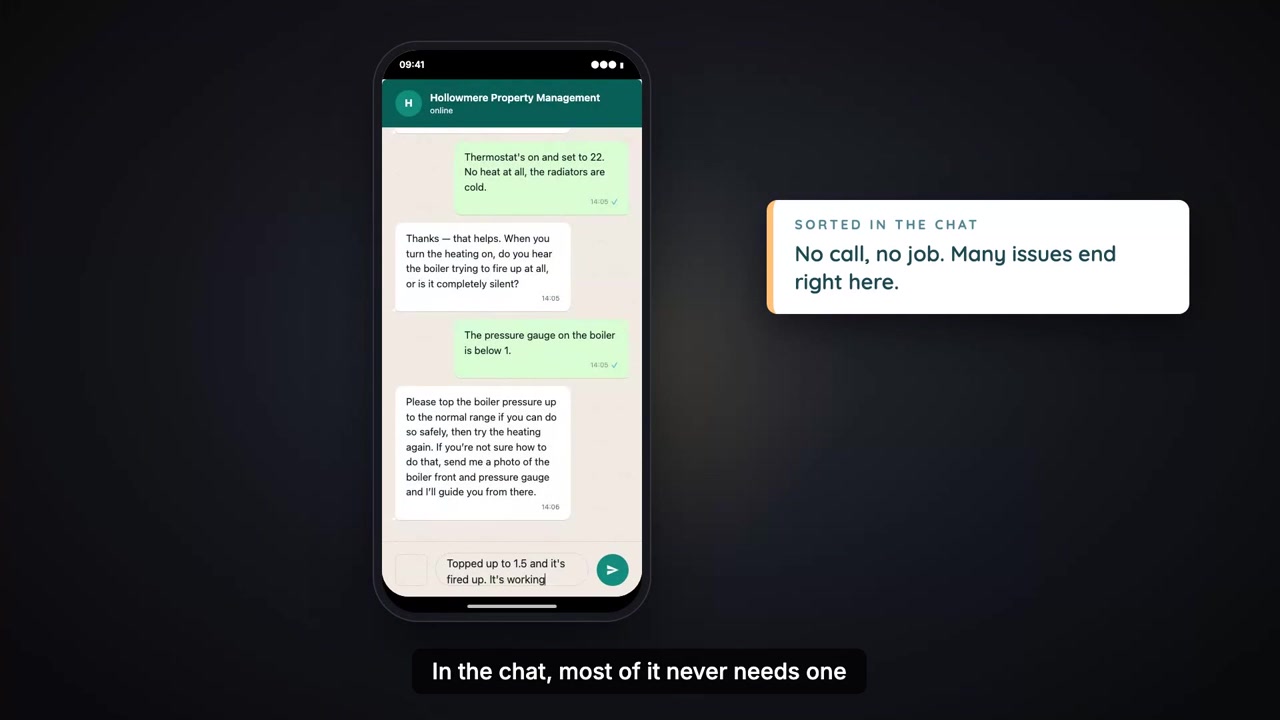
If a straightforward issue can be resolved safely through initial triage, why should it become a maintenance job at all?
Technology shouldn't simply create a better record of administrative work.
It should reduce the amount of administrative work that needs to happen.
Not every maintenance report needs to become a job
This is particularly important at the beginning of the maintenance journey.
A tenant reports:
“The heating isn't working.”
Traditionally, that can immediately become a maintenance task.
But there are several things we'd ideally know first.
Is the boiler displaying an error?
What's the pressure reading?
Is the thermostat on?
Is the issue affecting heating, hot water or both?
Can the tenant safely provide a photograph?
Has a simple troubleshooting step already been attempted?
Collecting that information before the issue reaches the Property Manager changes the nature of the work.
Instead of beginning with:
“What's actually wrong?”
the Property Manager can begin with:
“What should we do?”
And sometimes the issue can be resolved before it needs to become a contractor job at all.
That's not merely digitising maintenance.
That's removing unnecessary work from the process.
Automation shouldn't mean removing the Property Manager
There's an understandable concern whenever automation enters a people-focused profession.
Does this mean replacing people?
I think that asks the wrong question.
Great Property Managers bring things technology doesn't.
Judgement.
Experience.
Empathy.
Negotiation.
Relationship management.
The ability to recognise when an apparently straightforward situation isn't straightforward at all.
Those are exactly the things we should be protecting their time for.
A Property Manager shouldn't be valuable because they can remember that a contractor needs chasing at 3pm.
They shouldn't have to hold dozens of outstanding actions in their head.
And they shouldn't spend their afternoon searching through emails to reconstruct a conversation that already happened.
Don't automate the judgement. Automate everything that unnecessarily consumes the person with the judgement.
The test I'd apply to property technology
There's a simple question I'd increasingly ask of any technology used in property management:
What does this actually take away?
Not what does it record?
Not how many features does it have?
Not how impressive is the dashboard?
What work no longer has to be done because the technology is there?
Does it reduce chasing?
Does it remove duplicate communication?
Does it gather information before somebody needs to ask for it?
Does it keep the right people updated automatically?
Does it make ownership clear?
Does it identify what's waiting and why?
Does it create the evidence trail as the work happens?
Does it allow an experienced Property Manager to spend more time managing exceptions and less time managing administration?
If the answer is no, we may have digitised the process without really improving it.
The next step isn't more technology
Property management probably doesn't need another layer of technology simply for the sake of having more technology.
It needs technology that takes greater responsibility for the operational work.
That's a principle we've thought about a lot while building Nestsen.
From the moment an issue is reported, the aim should be to capture useful information, triage where appropriate, keep communication connected, coordinate what happens next and maintain the timeline through to resolution.
The Property Manager remains in control.
But they shouldn't have to manually hold every part of the process together.
Because the future of property management isn't about putting more work onto screens.
And it isn't about removing good Property Managers.
It's about removing more of the unnecessary work from good Property Managers.
We've already digitised property management.
Now we need to make it easier.
How much of your team's day is still spent chasing maintenance?
Nestsen brings maintenance, communication, contractors, updates and the complete audit trail into one connected journey — while intelligent triage helps prevent unnecessary work reaching the Property Manager in the first place.
See how Nestsen works → Book a Free Demo - Nestsen Property Management Software
Share this article
See Nestsen in action
Join property managers across the UK who have cut response times, reduced compliance risk and kept tenants happier with Nestsen.
Book a free demo →You might also like

Your Best Property Manager Shouldn't Be Your Operating System
1 October 2026
Why Property Maintenance Is a Landlord Retention Strategy
1 October 2026
If Your Property Manager Has to Remember Who Needs Chasing, the System Isn’t Doing Enough
1 October 2026

When Protecting Tenants Makes It Harder to Become One
25 August 2026