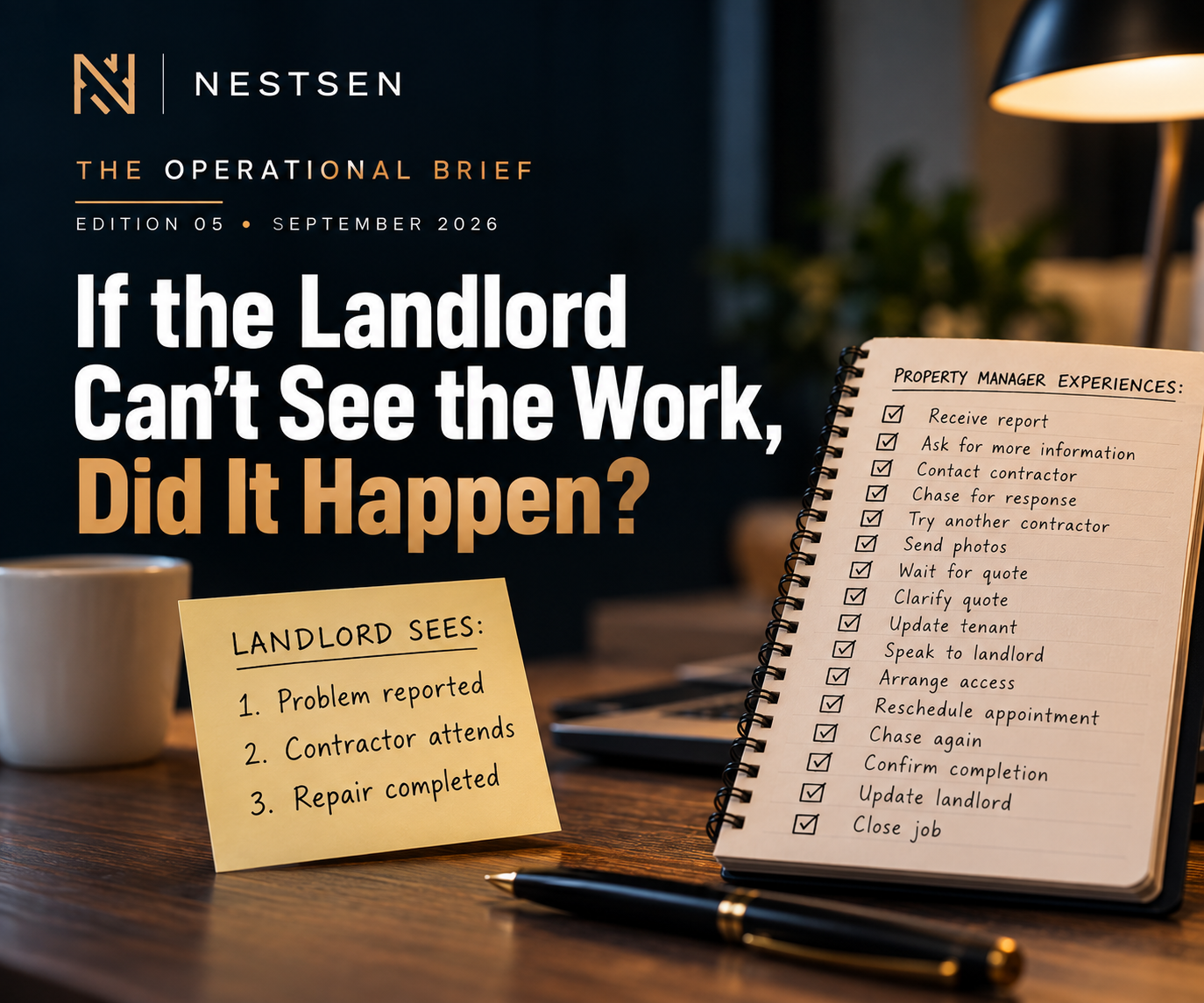
If the Landlord Can't See the Work, Did It Happen?
If the Landlord Can't See the Work, Did It Happen?
The invisible work of property management — and why it matters more than we think.
A tenant reports a leaking tap.
The landlord receives an update.
A contractor attends.
The tap gets fixed.
Job done.
From the landlord's perspective, that might be the entire story.
Four steps. One repair. Problem solved.
But anyone who's spent time in property management knows there's often another story happening behind the scenes.
And it's usually a considerably longer one.
The repair that took 20 conversations
Let's take that leaking tap.
The tenant reports the problem, but the initial description isn't particularly helpful.
The Property Manager asks for photographs.
The photographs arrive, but they don't show where the leak is coming from.
Another message.
A phone call.
Eventually, there's enough information to understand the issue.
The Property Manager contacts a contractor.
No answer.
Tries another.
Gets a response, but the contractor can't attend until Thursday.
The tenant isn't available Thursday.
More messages.
Another contractor is contacted.
A quotation is requested.
The landlord needs to approve the cost.
The landlord asks whether it's really necessary.
The Property Manager explains the risk of leaving it unresolved.
Approval arrives.
The contractor is booked.
The tenant confirms access.
Then, on the morning of the appointment, the contractor calls to say he's running late.
Another call to the tenant.
Another update.
The contractor finally attends.
The repair is completed.
The Property Manager checks that everything is working, confirms the cost and updates the landlord.
One leaking tap.
Potentially 15 or 20 separate interventions.
And what does the landlord see?
Tap repaired.
The problem isn't that the work isn't happening
It's that much of it is invisible.
Property management has always involved a considerable amount of work that happens away from the landlord's view.
Phone calls.
Emails.
WhatsApp messages.
Contractor chasing.
Tenant reassurance.
Access arrangements.
Approvals.
Unexpected complications.
And perhaps most importantly, the judgement required to keep everything moving.
Experienced Property Managers make hundreds of small decisions that prevent relatively minor issues from becoming much bigger problems.
But those decisions rarely appear on a landlord statement.
They don't feature prominently in a monthly report.
And when everything goes smoothly, they're often completely unnoticed.
There's a strange irony here.
The better a Property Manager is at preventing problems, the less obvious their contribution can become.
The commercial cost of invisible work
This matters for reasons that go well beyond recognition.
Think about how a landlord evaluates the management service they're paying for.
They can see the monthly fee.
They can see the contractor's invoice.
They can see the final result.
But can they see the work that connected those things?
Often, not particularly well.
And when the work isn't visible, it becomes much easier to underestimate.
A landlord might reasonably ask:
What am I actually paying my management fee for?
It's not necessarily an unfair question.
If the only evidence of the service is a completed repair and an invoice, how are they supposed to understand everything that happened in between?
The Property Manager knows.
The contractor probably knows.
The tenant may have some idea.
But the person paying for the management service might have the least complete picture of all.
That's a problem.
Not because landlords need to know about every telephone call.
They don't.
But because the value of professional property management shouldn't depend on a landlord taking that value entirely on trust.
Trust matters enormously.
Visibility helps build it.
We're very good at recording outcomes
Property management systems have become increasingly sophisticated.
We can record maintenance requests.
Allocate jobs.
Store invoices.
Track expenditure.
Maintain compliance records.
Produce reports.
All important.
But there's a difference between recording that something happened and showing how it happened.
A completed maintenance ticket tells us the repair was finished.
It doesn't necessarily tell us that the Property Manager spent three days trying to secure access.
Or that the first contractor cancelled.
Or that the landlord's approval took two days.
Or that the tenant needed reassurance because the problem was affecting their ability to use the property.
Those details provide context.
And context changes how people perceive performance.
Without it, a repair that took six days might look like poor service.
With it, the landlord might discover that the Property Manager responded within minutes, arranged a contractor promptly and spent the remaining time working around circumstances outside their control.
Same repair.
Same completion date.
Very different understanding of the service delivered.
Visibility isn't about sending more updates
There's an obvious objection to all this.
Property Managers are already drowning in administration.
The last thing they need is another requirement to document every action, justify every decision or produce another report.
I couldn't agree more.
The answer isn't to ask Property Managers to spend even more time proving how busy they are.
And it certainly isn't to copy landlords into every contractor conversation.
That would create more noise, not more understanding.
The answer is to make the work that's already happening easier to see.
If a maintenance issue moves through several stages, there should be a clear record of those stages.
If approval is requested, that should be visible.
If a contractor cancels, that should be recorded.
If the tenant has been updated, there should be evidence of that communication.
Not because someone has spent an extra hour writing a report.
But because those actions are part of the normal process.
The record should be a by-product of doing the work.
Not another job in itself.
There's a difference between activity and value
Of course, not every phone call or email represents value.
Twenty interventions aren't automatically better than five.
Sometimes they're evidence of a process that isn't working particularly well.
And that's an important distinction.
The goal shouldn't be to demonstrate how complicated property management has become.
It should be to understand where the effort goes, which actions genuinely add value and which ones could be eliminated.
If a repair requires six calls because nobody knows who's responsible for the next step, that's not a success story.
That's an opportunity to improve the process.
But if a Property Manager makes three well-judged interventions that prevent a costly escalation, that's absolutely worth understanding.
Visibility should help us recognise good work and identify unnecessary work.
Both matter.
A better conversation with landlords
Imagine two conversations.
In the first, a landlord asks why a repair took a week.
The Property Manager has to reconstruct what happened from emails, phone calls, WhatsApp messages and memory.
They explain that the contractor was unavailable, the tenant couldn't provide access and approval took longer than expected.
The landlord may accept the explanation.
Or they may feel they're hearing excuses.
Now imagine the same conversation with a clear timeline.
Monday: Issue reported and assessed.
Monday: Contractor contacted.
Tuesday: Quotation received and approval requested.
Wednesday: Approval received.
Thursday: Appointment agreed with tenant.
Friday: Repair completed and confirmed.
The landlord can see what happened, when it happened and where the delays occurred.
No lengthy reconstruction.
No reliance on memory.
No unnecessary defensiveness.
Just a shared understanding of the facts.
And that changes the conversation.
It moves the discussion away from Why did this take so long?
Towards What could we do differently next time?
That's a much healthier place for a landlord-agent relationship to be.
The best work shouldn't be the hardest to demonstrate
Property management is becoming more demanding.
Expectations are rising.
Responsibilities are expanding.
And landlords understandably want to know they're receiving value for the fees they pay.
But I think the industry sometimes makes demonstrating that value unnecessarily difficult.
We ask Property Managers to coordinate increasingly complex work across multiple people, communication channels and systems.
Then, when somebody asks what they've actually done, we expect them to piece the evidence together afterwards.
That doesn't make much sense.
We should be building processes where the work, the decisions and the progress are visible as they happen.
Not to monitor every minute of someone's day.
Not to overwhelm landlords with information.
And certainly not to celebrate inefficiency.
But to make the contribution of good property management easier to understand.
Because a landlord shouldn't have to guess whether their agent is doing a good job.
And a Property Manager shouldn't have to spend another hour proving it.
The work is already happening.
It's time we made its value easier to see.
Stephen Marr is Co-Founder and Commercial Director of Nestsen, a platform focused on maintenance coordination, communication and operational visibility for letting agents.
Nestsen - Maintenance Operations Software for UK Letting & Managing Agents
Share this article
See Nestsen in action
Join property managers across the UK who have cut response times, reduced compliance risk and kept tenants happier with Nestsen.
Book a free demo →You might also like
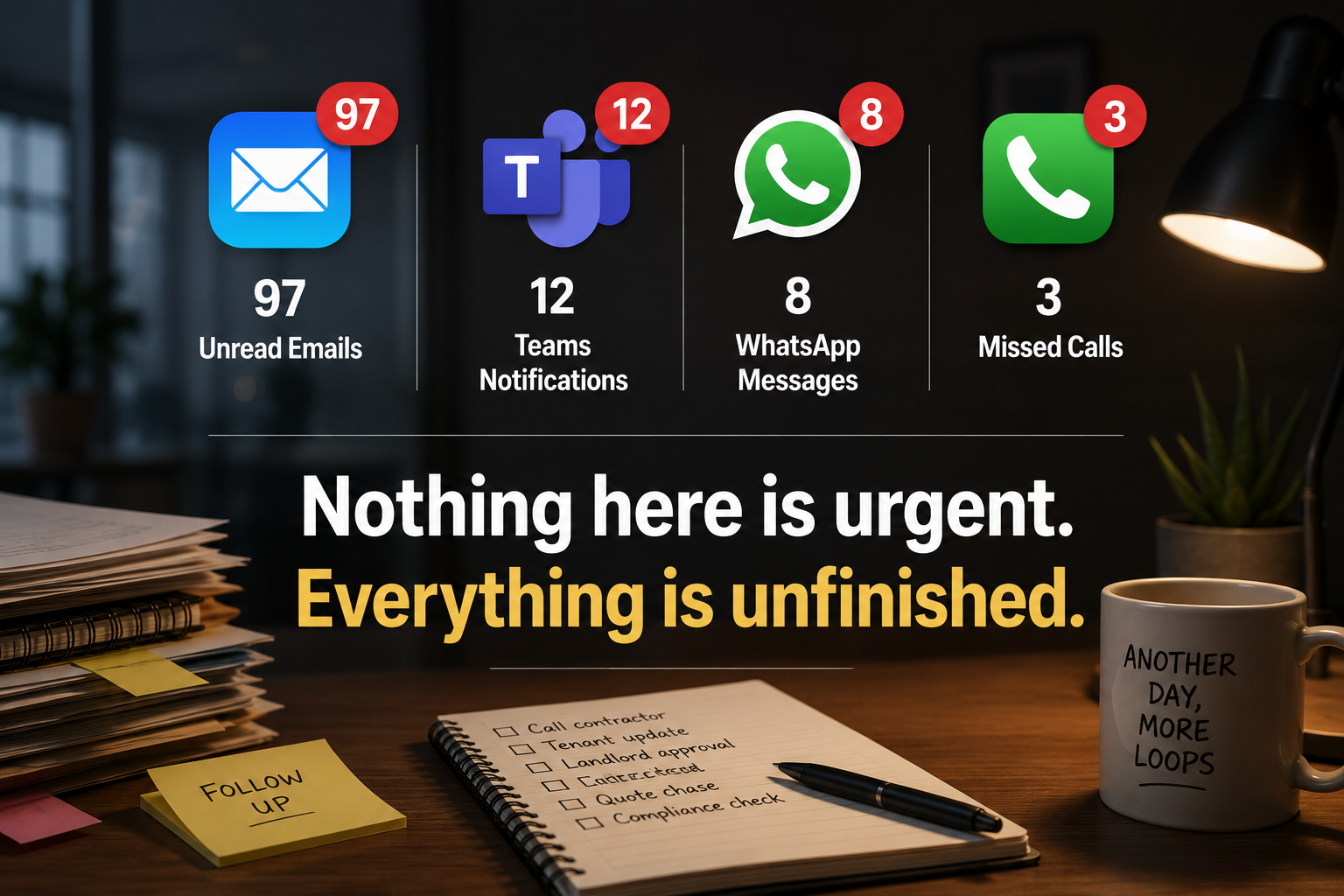
The Hidden Mental Load of Property Management: Why Unfinished Work Follows People Home
13 October 2026

Have We Digitised Property Management Without Making It Easier?
3 October 2026

Your Best Property Manager Shouldn't Be Your Operating System
1 October 2026
Why Property Maintenance Is a Landlord Retention Strategy
1 October 2026