If Your Property Manager Has to Remember Who Needs Chasing, the System Isn’t Doing Enough
If Your Property Manager Has to Remember Who Needs Chasing, the System Isn’t Doing Enough
A tenant reports an issue.
The contractor doesn’t respond.
The tenant wants an update.
The landlord wants to know what’s happening.
None of this sounds particularly complicated.
But multiply it across dozens, hundreds or even thousands of properties and something changes.
Property Managers aren’t simply managing maintenance jobs anymore. They’re remembering conversations, outstanding actions, promises, deadlines and who needs chasing next.
And far too often, the Property Manager becomes the system.
The Property Manager shouldn’t be the system’s memory
Think about what can sit behind even a relatively straightforward maintenance issue.
Has the tenant provided enough information?
Does the issue actually require a contractor?
Has someone been instructed?
Did they respond?
Has access been arranged?
Is the tenant waiting for an update?
Does the landlord need to approve something?
Has the work been completed?
Is there evidence of completion?
What happens next?
Individually, these are small things.
The difficulty comes when a Property Manager is carrying dozens of them simultaneously across multiple maintenance issues.
Some will be written in emails. Some may be in WhatsApp conversations. Others could be in notes, telephone calls or a property management system.
But if someone still has to remember to go back and check them, the operational burden hasn’t disappeared.
If the system records what happened but the Property Manager still has to remember what needs to happen next, the system is only doing half the job.
Recording maintenance isn’t the same as managing it
Property management technology has become very good at storing information.
We can create jobs, add notes, upload documents and record conversations.
That has enormous value.
But storing information and actively helping manage a process are two different things.
A system of record can tell you that a contractor was contacted on Tuesday.
The Property Manager may still need to remember that the contractor hasn’t replied by Thursday.
It can show that a tenant reported a problem.
Someone may still need to work out whether the issue actually requires a contractor.
It can record that work was completed.
Someone may still need to establish whether there is sufficient evidence to demonstrate what was actually done.
That distinction matters.
Technology shouldn’t simply provide another place for Property Managers to record the work they are already doing.
It should help reduce the amount of work they need to do in the first place.
Not every maintenance report needs to become a job
There is another opportunity to reduce workload before the maintenance journey has even properly started.
A tenant reports a problem based on what they are experiencing.
That doesn’t necessarily mean they know what is causing it.
“Boiler not working.”
“Radiator cold.”
“Lights have gone out.”
“Water isn’t draining.”
The easy response is to create a job and send it to a contractor.
But the right questions at the beginning can make an enormous difference.
What exactly is happening?
When did it start?
Has anything changed?
Where is the issue located?
Is there useful photographic evidence?
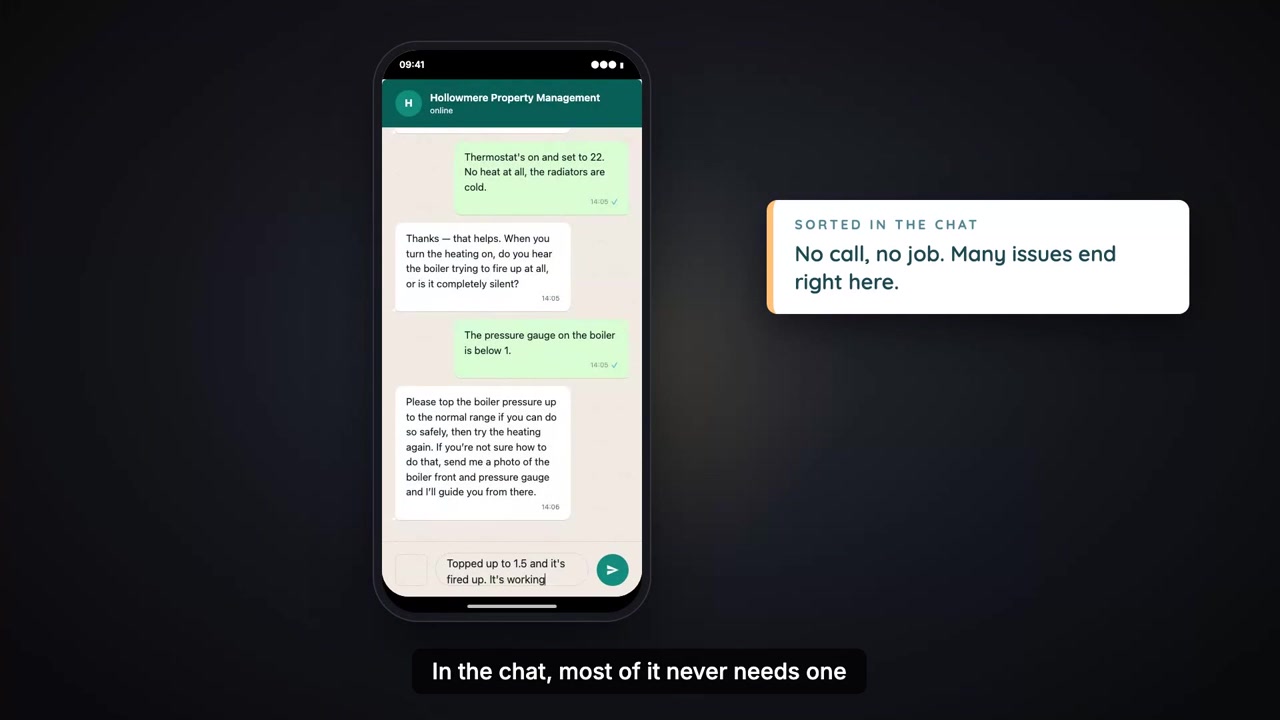
Are there appropriate checks that can be made before someone is sent to the property?
Good triage can provide a Property Manager with much better information before they become involved. In some circumstances, an issue may even be resolved without becoming a contractor job at all.
That means fewer unnecessary call-outs, less administration and less time spent coordinating work that may never have been required.
The real cost of chasing
It’s easy to underestimate the cost of chasing because each individual action can look insignificant.
An email might take two minutes.
A phone call might take five.
Checking whether somebody responded could take less than a minute.
But that isn’t the whole cost.
The Property Manager has to remember that something needs checking.
They have to stop what they’re doing, return to the issue, establish where things were left, take the next action and then remember to come back again if nothing happens.
Across an entire portfolio, those interruptions accumulate.
The expensive part of chasing isn’t always the chase. It’s remembering that something needs chasing.
That mental load is difficult to see on a spreadsheet, but Property Managers experience it every day.
It contributes to the feeling of constantly being busy while still worrying that something somewhere may have been missed.
Maintenance should create its own operational trail
A better maintenance process should make it easy to understand what has happened without reconstructing the story.
From the initial tenant report through to resolution, the relevant information, communication, actions and evidence should remain connected.
Who reported the issue?
What information was provided?
What happened during triage?
Who was contacted?
What did they say?
What is outstanding?
When did the contractor attend?
What work was completed?
What evidence exists?
When those pieces are connected, visibility improves.
The Property Manager doesn’t need to search through different places to work out where an issue stands.
A colleague can understand what is happening without asking the person managing the job.
And if a landlord later asks what happened, there is a clear operational timeline rather than a reconstruction from emails, notes and memory.
Technology should do some of the work
This is one of the principles behind Nestsen.
We don’t believe maintenance technology should simply provide somewhere else to record a repair.
Nestsen helps manage the journey from the initial tenant report through to resolution.
Issues can be triaged at the beginning of the process, useful information and evidence captured upfront, and communication and actions kept connected as the issue progresses.
The aim is straightforward:
Less unnecessary work.
Less chasing.
Better visibility.
Property Managers will always be central to good property management.
Their experience, judgement and ability to deal with people can’t simply be replaced by a workflow.
But those skills are valuable.
They shouldn’t be consumed by remembering that a contractor hasn’t replied to an email.
Let Property Managers manage
The best technology doesn’t remove the Property Manager from property management.
It removes some of the operational burden surrounding them.
It should help surface what needs attention, maintain the history of what has happened and make the next action clearer.
Because when a Property Manager has to keep the maintenance operation running from memory, the system isn’t supporting them enough.
And when technology can take more of that burden away, Property Managers have more time for the work that genuinely needs them.
Is maintenance taking up too much of your team’s time?
Nestsen helps letting agents manage maintenance from the initial tenant report through to resolution, keeping the communication, actions and evidence connected along the way.
Book a Nestsen demo and see how it works.
Share this article
See Nestsen in action
Join property managers across the UK who have cut response times, reduced compliance risk and kept tenants happier with Nestsen.
Book a free demo →You might also like