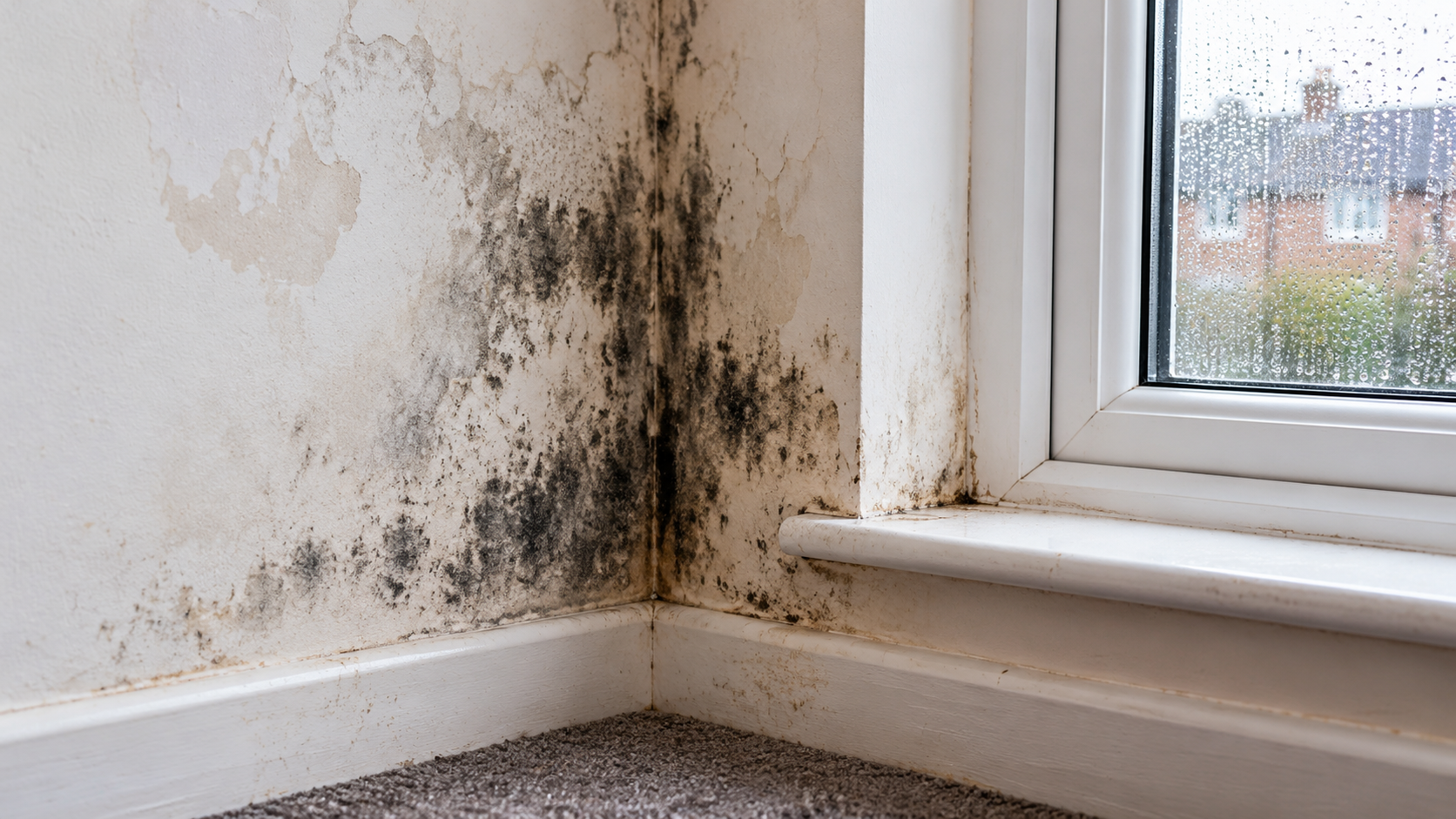
Awaab's Law: What Landlords and Letting Agents Need to Know About Damp and Mould
Damp and mould remain among the most concerning maintenance issues facing the UK rental sector.
Recent YouGov research commissioned by Safeguard Europe reported that 54% of private renters had experienced damp or mould in their homes within the previous year.
More than half.
For landlords, letting agents and property managers, this raises important questions about maintenance management, communication, accountability and tenant safety.
In 2020, two-year-old Awaab Ishak tragically died following prolonged exposure to mould in his home. His death led to significant legislative changes intended to ensure that dangerous housing conditions are addressed more quickly.
The introduction of Awaab's Law in social housing, and its forthcoming extension to the private rented sector in England, represents a fundamental shift in how serious maintenance issues must be managed.
But what does Awaab's Law mean for private landlords and letting agents, and how can they prepare?
What Is Awaab's Law?
Awaab's Law introduces legally enforceable deadlines for social housing landlords in England to investigate and address dangerous housing conditions.
The legislation places greater emphasis on timely intervention, effective communication and ensuring that residents are protected from hazards within their homes.
The first phase came into force on 27 October 2025, covering significant damp and mould hazards and all emergency hazards.
The second phase, commencing on 30 November 2026, extends requirements to additional hazards, including excessive cold, electrical dangers, fire risks and structural instability.
A further expansion is planned for 2027.
The underlying principle is simple. Residents should not be left living in unsafe conditions because maintenance issues have been delayed, overlooked or inadequately addressed.
Does Awaab's Law Apply to Private Landlords?
As of November 2026, the specific statutory repair deadlines introduced under Awaab's Law apply to social housing rather than private rented tenancies.
However, that is changing.
The Renters' Rights Act 2025 provides for extending Awaab's Law to the private rented sector in England.
On 9 October 2026, the government launched a consultation examining how these requirements should apply to private landlords and certain other types of accommodation.
The consultation considers:
Which housing hazards should be covered.
How investigations should be conducted.
Appropriate repair deadlines.
The circumstances of vulnerable tenants.
Implementation timescales.
The operational and financial impact on landlords and letting agents.
The consultation closes on 18 December 2026.
The final implementation date and detailed requirements for private rented tenancies have not yet been established.
However, landlords and letting agents would be wise to review their maintenance processes now rather than wait until the new regulations come into force.
Awaab's Law and Damp and Mould Repair Deadlines
The deadlines currently applying to social housing provide an important indication of the direction of future regulation.
Maintenance requirement | Current social housing deadline |
|---|---|
Investigation of a potential significant damp or mould hazard | Within 10 working days of awareness |
Written communication of investigation findings | Generally within 3 working days of investigation completion |
Action to make a significant hazard safe | Within 5 working days of investigation completion |
Emergency hazards | Investigated and made safe within 24 hours |
Alternative accommodation | Required where safety cannot be restored within the applicable deadline |
Additional requirements apply where further preventative work is necessary.
Importantly, making a property safe is not necessarily the same as completing every permanent repair. Temporary protective measures may be appropriate while more extensive remedial works are undertaken.
These deadlines currently relate to social housing in England. Private sector requirements remain subject to further regulations.
What Are Landlords' Existing Responsibilities for Damp and Mould?
Although Awaab's Law has not yet been fully implemented in the private rented sector, private landlords already have legal responsibilities relating to housing conditions.
These include obligations under:
The Landlord and Tenant Act 1985.
The Homes (Fitness for Human Habitation) Act 2018.
The Housing Act 2004.
The Environmental Protection Act 1990.
Depending on the circumstances, landlords may be responsible for addressing structural defects, leaks, inadequate heating, ventilation problems and other conditions contributing to damp and mould.
Serious housing hazards can also result in local authority enforcement action.
Landlords should not delay necessary repairs while waiting for Awaab's Law to be extended to private rented tenancies.
Why Damp and Mould Should Never Be Treated as Routine Maintenance
Not every maintenance issue presents the same level of risk.
A broken cupboard handle and extensive mould in a child's bedroom cannot reasonably be managed with the same sense of urgency.
Damp and mould can have serious consequences for respiratory health, particularly for young children, older residents and people with existing health conditions.
The severity of a maintenance issue must therefore be considered alongside the circumstances of the people living in the property.
Effective maintenance reporting should capture more than a brief description of the problem.
Property managers need to understand:
Where the damp or mould is located.
How extensive the problem appears to be.
Whether the problem is recurring or worsening.
Whether there are potential underlying leaks or structural issues.
Whether residents have identified particular health concerns or vulnerabilities.
Whether immediate professional intervention is necessary.
Gathering appropriate information at the beginning of the maintenance journey can help teams make better decisions about urgency, investigation and escalation.
However, photographs and initial reports should not replace professional investigation where a significant hazard may exist.
The Hidden Risk Between Reported and Resolved
One of the biggest challenges facing property management teams is not necessarily receiving maintenance reports.
It is ensuring those reports progress through to resolution.
Consider a tenant who reports mould in a bedroom.
The property manager receives an email and asks for photographs. The landlord is contacted. A contractor is instructed. An appointment needs to be arranged. Further investigation may be required.
Meanwhile, the tenant is still living with the problem.
At any stage, progress can stall.
“We're waiting for the landlord.”
“The contractor hasn't responded.”
“I thought someone had dealt with that.”
“We're still waiting for an update.”
Four familiar sentences within property management.
And potentially weeks of delay.
Of course, some maintenance problems require extensive investigation, specialist contractors and considerable investment.
But poor communication, unclear responsibilities and fragmented information should never be the reason a serious housing hazard becomes worse.
A report logged isn't a problem solved.
A contractor contacted isn't a repair completed.
A tenant updated isn't necessarily a tenant protected.
The distinction between recording maintenance and resolving maintenance is becoming increasingly important.
How Letting Agents Can Prepare for Awaab's Law
Letting agents do not need to wait for the final private sector regulations before improving their maintenance processes.
There are several practical steps agencies can take today.
1. Review How Tenants Report Maintenance Issues
Maintenance reporting should be straightforward and accessible.
Tenants should know how to report problems, including urgent hazards outside normal office hours.
Agencies should ensure important reports are not overlooked because they arrive through different communication channels.
2. Establish Effective Maintenance Triage
Not all maintenance requests require the same response.
A structured triage process helps teams identify potentially serious hazards, gather relevant information and escalate urgent cases appropriately.
The objective should be to identify risk early rather than discover it after unnecessary delays.
3. Review Contractor Coordination
Can your team easily establish whether a contractor has accepted an instruction, arranged an appointment or completed an investigation?
If this information depends on repeated telephone calls and emails, maintaining visibility across a large portfolio becomes increasingly difficult.
Clear contractor workflows can help prevent important maintenance issues from stalling.
4. Improve Landlord Communication and Approvals
Landlords need timely information about serious maintenance issues and their responsibilities.
Letting agents should establish clear escalation procedures where approvals are delayed, particularly when a potential health or safety hazard has been identified.
Administrative approval processes must not become an obstacle to meeting legal safety obligations.
5. Maintain a Complete Maintenance Audit Trail
Being able to establish what happened, when it happened and who was involved is increasingly important.
An effective maintenance audit trail should capture:
When the issue was first reported.
Information and photographs provided by the tenant.
Risk assessments and investigation findings.
Communication with landlords and contractors.
Instructions, decisions and approvals.
Appointment and access arrangements.
Remedial work and evidence of completion.
Subsequent checks where necessary.
This information should be readily accessible rather than scattered across personal inboxes, telephone notes and messaging applications.
6. Confirm That the Underlying Problem Has Been Addressed
Closing a maintenance job should mean more than confirming that a contractor attended the property.
Damp and mould can return if the underlying cause has not been properly resolved.
Appropriate follow-up inspections or communication with residents can help identify recurring problems before they become more serious.
How Property Maintenance Software Can Support Awaab's Law Compliance
As regulatory expectations increase, property managers need systems that support their responsibilities without creating additional administrative pressure.
Nestsen is a dedicated property maintenance, communication and audit trail platform that manages the maintenance journey from initial tenant report through to resolution.
Nestsen brings together:
AI-assisted maintenance reporting and triage.
Structured information collection from tenants.
Contractor coordination and progress tracking.
Tenant communication and updates.
Landlord visibility and approvals.
A complete, timestamped maintenance audit trail.
Integration with existing letting agency CRM systems through GlueDog.
By bringing maintenance activity into a connected workflow, Nestsen helps property management teams maintain visibility, identify outstanding actions and reduce dependency on fragmented communication.
Technology cannot replace professional judgement, qualified inspections or a landlord's legal responsibilities.
However, it can help ensure that the information, communication and coordination needed to fulfil those responsibilities are more effectively managed.
From Recording Maintenance to Resolving Maintenance
Awaab's Law is ultimately about protecting people in their homes.
For landlords and letting agents, preparing for its extension means more than understanding new legislation or adding another compliance checklist.
It means reviewing how maintenance issues are reported, investigated, communicated, escalated and resolved.
The industry has become increasingly effective at recording maintenance.
Now it needs to become equally effective at resolving it.
Because when maintenance stalls, the consequences don't.
Discover how Nestsen helps letting agents and property managers bring maintenance communication, contractor coordination and accountability into one connected platform.
Visit Nestsen and book a free demonstration.
Nestsen. Properties, Homes, Nurtured.
Fix it before it's broken.
This article provides general information about housing legislation in England and does not constitute legal advice. Readers should consult current government guidance and seek professional advice where appropriate.
Share this article
See Nestsen in action
Join property managers across the UK who have cut response times, reduced compliance risk and kept tenants happier with Nestsen.
Book a free demo →You might also like
How to Reduce Property Management Workload: 6 Things to Check Before Hiring Another Property Manager
20 November 2026
Letting Agency CRM Integration: How Nestsen and GlueDog Simplify Property Maintenance
20 November 2026

Property Management Has a Wellbeing Problem. But Are We Addressing the Right Causes?
1 November 2026
If the Landlord Can't See the Work, Did It Happen?
14 October 2026