The hidden operational bottleneck in modern lettings
The hidden operational bottleneck in modern lettings
Hiring more people feels like the obvious solution in property management.
But it rarely fixes the problem.
Things get busy. Hire.
Things get messy. Hire.
Things fall behind. Hire.
And yet, the day to day does not change.
Chasing.
Clarifying.
Re routing.
Following up.
So now there are more people involved.
But the same problems still exist.
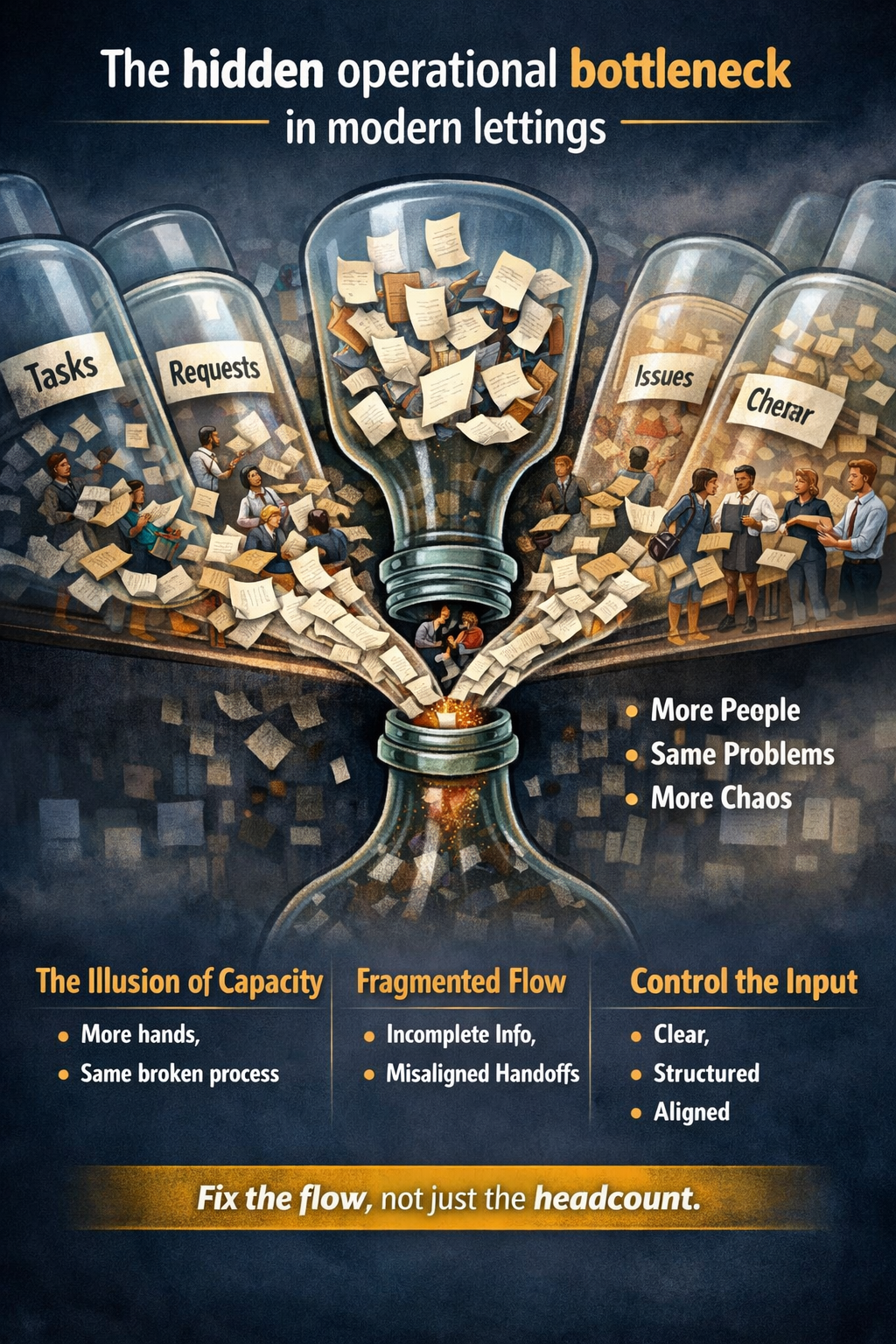
The illusion of capacity
On paper, adding headcount should relieve pressure.
More hands. More output.
But in practice, it often just spreads the inefficiency.
More people touching the same broken process
More handoffs
More duplication
More room for misalignment
The workload increases without the system improving.
Where the real issue sits
The problem is not capacity.
It is flow.
How work enters the system
How clearly it is defined
How it moves between people
How consistently it progresses
In most lettings operations, this flow is fragmented from the start.
Information arrives incomplete.
Context is missing.
Ownership is unclear.
So before a task can even be completed, it has to be rebuilt.
Why systems are not fixing it
Most systems do not solve this.
They organise it.
Dashboards track activity.
CRMs store information.
Task lists assign responsibility.
But none of them control the quality of what enters the workflow.
So teams are not just solving problems.
They are piecing them together first.
The compounding effect
At small scale, this is manageable.
At portfolio level, it becomes a bottleneck.
Delays stack.
Communication loops expand.
Errors increase.
And suddenly the operation feels constantly behind, regardless of team size.
The shift that actually matters
The solution is not more people.
It is control.
Control over what enters the system.
Control over how it is structured.
Control over how it moves from that point on.
When inputs are clean and consistent, everything downstream improves.
Less chasing
Less duplication
Less ambiguity
Work flows instead of being forced through.
What this looks like in practice
Instead of rebuilding context every time, it is carried forward.
Instead of rechecking the same information, it is already verified.
Instead of coordinating manually, the process progresses by design.
The team shifts from managing chaos to operating a system.
Final thought
“We need more people” has become the default answer in property management.
But more people on top of a broken flow just creates a bigger version of the same problem.
The real leverage comes from fixing how the work moves.
Because in modern lettings, operational clarity is what scales.
If your team is growing but the workload still feels chaotic, the issue is probably not capacity.
It is flow.
Share this article
See Nestsen in action
Join property managers across the UK who have cut response times, reduced compliance risk and kept tenants happier with Nestsen.
Book a free demo →You might also like

The Hidden Mental Load of Property Management: Why Unfinished Work Follows People Home
12 October 2026

Have We Digitised Property Management Without Making It Easier?
3 October 2026

Your Best Property Manager Shouldn't Be Your Operating System
1 October 2026
Why Property Maintenance Is a Landlord Retention Strategy
1 October 2026