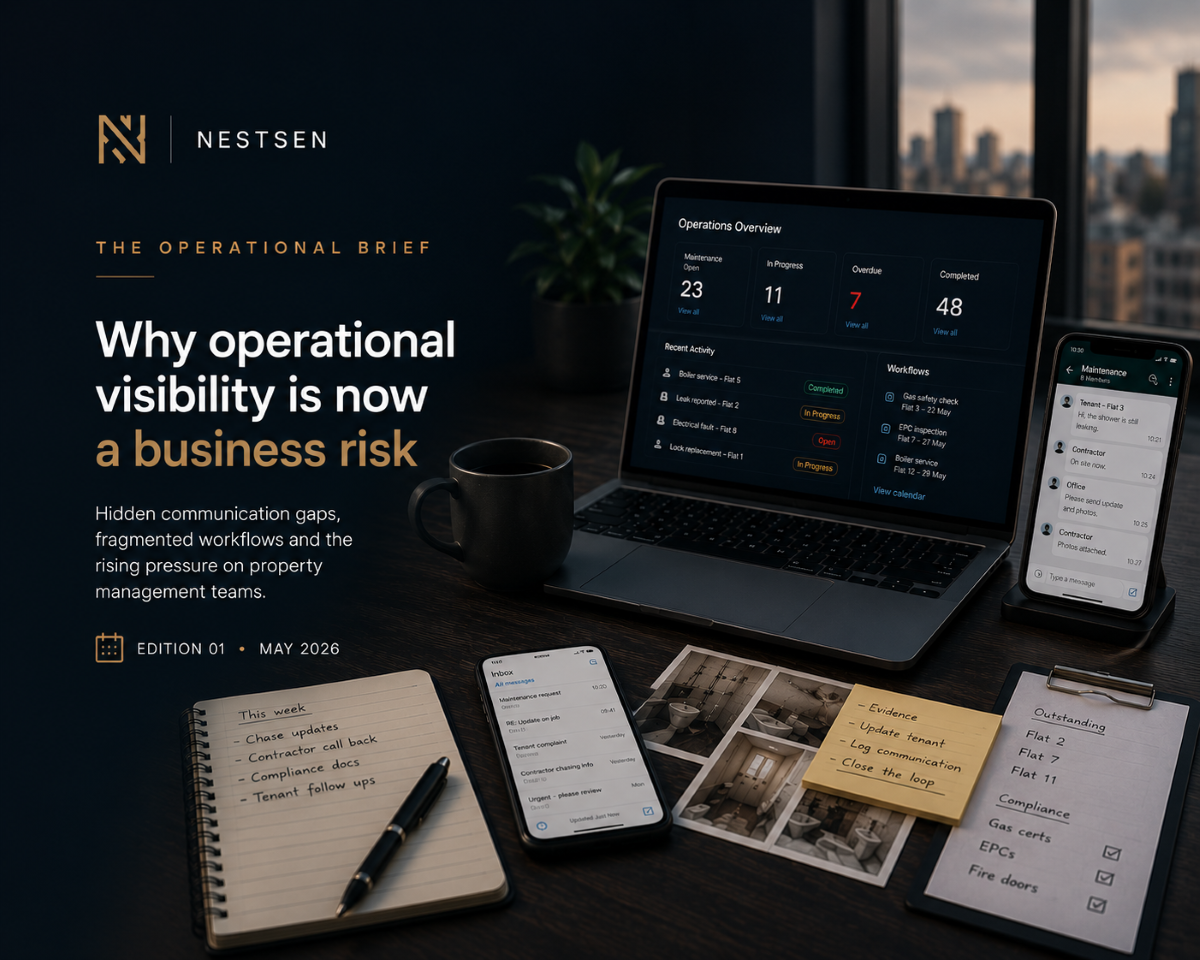
The Growing Gap Between Information And Visibility
The Growing Gap Between Information And Visibility
Stephen Marr
Co-Founder @ Nestsen | Helping Letting Agents Reduce Operational Noise, Improve Visibility & Strengthen Audit Trails
May, 2026
The Operational Brief
The visibility gap inside modern property management
When every maintenance issue creates a trail across email, WhatsApp, phone calls and memory, visibility becomes the real constraint.
By Stephen Marr, Co-Founder, Nestsen
This issue in one line - property management teams are being judged on consistency, while too much of the maintenance trail still sits outside the place where the work is managed.
This month's observation
Over the past few weeks, one pattern has kept coming up in conversations with people across lettings and property management.
The pressure is coming from the trail that forms around each maintenance issue: updates, contractor responses, tenant calls, internal handovers and the evidence that must be found later.
A team can have good people and established processes yet still struggle to see what is happening in real time once work spreads across several channels.
This first edition looks at that shift. It is about visibility, fragmentation and the pressure that builds when the operating picture must be rebuilt from memory.
INDUSTRY SIGNAL
The pressure is moving into execution
The industry is looking at legislation. The operational strain is sitting in execution.
The Renters' Rights conversation has pushed compliance to the front of the industry agenda. The daily strain is showing up in the work that follows each report.
Teams are asking whether they can maintain consistency when issue volume rises, tenant expectations increase and communication starts to spread.
The risk can look ordinary: a contractor update sitting in the wrong inbox, a tenant call that never makes it back into the system, or a decision that nobody can evidence two months later.
What to take from this: pressure builds when the business can no longer see the full maintenance trail without asking people to reconstruct it.
WHY THIS MATTERS
The default changed once before
"Fixflo became the default because email stopped scaling."
Email was never designed to be a maintenance operating system. As portfolios grew, the industry needed a clearer way to capture repairs, structure reports and move issues away from loose inbox threads.
That change gave teams a more consistent starting point. The next pressure point sits further along the workflow, after the report has been created and the work starts moving between tenants, contractors and internal teams.
Chasing, updating, checking, handing over and piecing together evidence all take time. When those actions sit across several channels, the system may record the issue without showing the full operating picture.
The issue gets logged. The operating picture still has to be found.
VISUAL INSIGHT
One repair, several trails
A single repair can create more operational movement than it appears to at first glance.
Tenant reports leak
→
Initial report captured
PM checks details
→
Clarification requested by email
Contractor replies
→
Update comes back on WhatsApp
Tenant calls office
→
New information sits in a call note
Internal handover
→
Colleague picks it up mid-flow
Job progresses
→
Status changes but not everyone sees it
Manager asks for history
→
Timeline has to be pieced together
Complaint or query arrives
→
Evidence needs to be found quickly
Operating picture
→
The repair was simple. The trail was not.
The issue is not the repair. The issue is reconstructing the trail afterwards.
FIELD NOTE
What happens when the inbox disappears
The risk is operational systems being held together by memory, inboxes and good people.
A property manager recently described what happened when their email system went down for 48 hours. Within hours, the operation began to split into separate channels.
Contractors moved to WhatsApp. Tenants started calling mobiles. Updates were screenshotted and shared manually.
The questions changed quickly: who spoke to the tenant, whether the contractor had actually been booked, and which version of the update was correct.
The striking part was that nothing unusual had happened to the portfolio. The outage simply exposed how much of the operation depended on people remembering the route a conversation had taken.
What to take from this: fragmentation often stays hidden until a system fails, a complaint arrives or a team has to evidence exactly what happened.
VISIBILITY
Most agencies have systems. The gap is visibility
"Most landlords and agents do not have a system problem. They have a visibility problem."
Many agencies already have processes, checklists and software in place. The harder question is whether those tools show what is happening across the whole operation on an ordinary day.
A completed job that was not logged, an update sent outside the system, or a decision made without a visible record may appear minor in isolation. Across a portfolio, those gaps make it harder to prove consistency.
Visibility reduces inbox archaeology.
Teams can see workload, ownership and evidence without rebuilding the story from memory.
WHERE NEXT
The next shift in property management
Less noise. Less chasing. Less fragmentation.
The next stage of property management operations will be shaped by the ability to reduce what reaches the team, structure the work that does reach them and keep the trail visible until the issue is resolved.
That means triage before issues become workload, clearer routing, consistent follow-up and audit trails that do not have to be rebuilt after the fact.
The future test for operational systems is simple: can the team see the truth of the workflow while pressure is building?
When the trail is visible
· handover is easier
· chasing reduces
· evidence is easier to find
· ownership is clearer
When the trail is scattered
· teams depend on memory
· updates get duplicated
· complaints take longer to answer
· confidence drops under scrutiny
The businesses that handle the next phase best will be the ones that keep visibility intact when volume rises.
BEHIND THE BRIEF
Why we are writing this
At Nestsen, we spend a lot of time speaking with letting agents, property managers and operational leaders.
The same themes keep appearing: fragmented communication, manual chasing, unclear ownership and pressure around evidence.
This briefing shares those observations in a structured format for teams thinking seriously about the operational side of property management.
Stephen Marr and Alistair Menzies, Co-Founders of Nestsen
Building Nestsen around structured workflows, operational clarity and reduced fragmentation across property management.
Nestsen helps letting agents reduce maintenance workload, improve visibility and strengthen audit trails.
Share this article
See Nestsen in action
Join property managers across the UK who have cut response times, reduced compliance risk and kept tenants happier with Nestsen.
Book a free demo →You might also like
The Hidden Mental Load of Property Management: Why Unfinished Work Follows People Home
12 October 2026

Have We Digitised Property Management Without Making It Easier?
3 October 2026

Your Best Property Manager Shouldn't Be Your Operating System
1 October 2026
Why Property Maintenance Is a Landlord Retention Strategy
1 October 2026