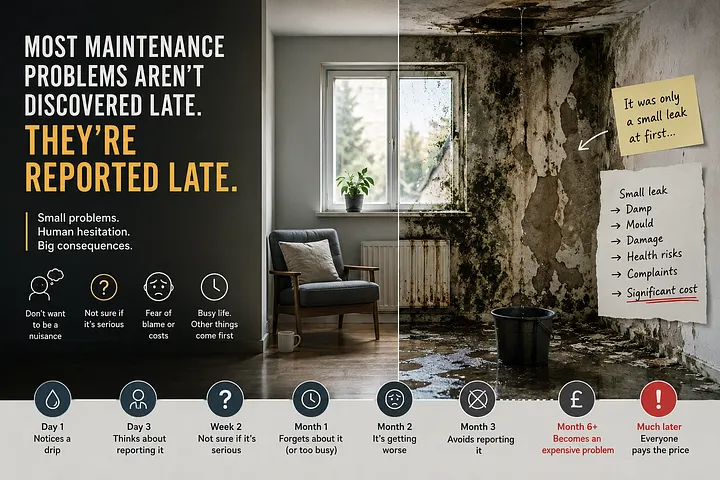
Most Maintenance Problems Aren’t Discovered Late. They’re Reported Late.
TLDR
When a maintenance issue becomes expensive, the conversation usually focuses on why it wasn’t fixed sooner.
A more useful question is often: why wasn’t it reported sooner?
Many tenants delay reporting problems not because they are careless, but because they are human. Understanding the psychology behind delayed reporting may be one of the most effective ways to improve property conditions, reduce costs, and prevent serious issues from developing.
Summary
In property management, we often think of maintenance as a process problem.
A tenant reports an issue.
A property manager assesses it.
A contractor attends.
The issue is resolved.
But that assumes the process starts when the issue appears. In reality, the process starts when the tenant decides to report it. That decision is influenced by psychology far more than most of us realise.
The gap between noticing a problem and reporting a problem is where many of the largest costs, risks, and frustrations in housing are created.
The Leaking Tap Problem
Imagine a tenant notices a dripping tap.
They don’t report it immediately. Not because they don’t care. Because life is busy. The drip is annoying but manageable.
They’re heading to work.
The kids need fed.
The washing machine has just broken.
The dripping tap moves to the bottom of the priority list.
A week passes. Then a month. Then another month.
The issue slowly becomes normal.
What started as a minor maintenance issue becomes part of everyday life.
This isn’t negligence. It’s human nature.
Nobody Wants To Be A Nuisance
One of the most common reasons tenants delay reporting issues is surprisingly simple.
They don’t want to bother anyone.
Many people are reluctant to raise concerns unless they believe the issue is serious enough to justify someone else’s time.
They tell themselves:
“It’s probably not that important.” “They’re busy.” “I’ll wait and see if it gets worse.”
This is especially common among older tenants, vulnerable tenants, and people who have previously felt ignored when reporting issues elsewhere.
The result is that small problems often remain hidden until they become large problems.
The Fear Of Being Blamed
Another powerful factor is uncertainty. Many tenants aren’t maintenance experts.
They don’t know:
Whether something is normal
Whether something is dangerous
Whether they have caused the problem themselves
If someone notices condensation around a window, they may wonder if they’re doing something wrong.
If mould appears, they may worry they’ll be blamed. If a leak develops, they may fear they’ll be charged for repairs.
When people fear negative consequences, they often avoid action altogether. Not because they don’t care, it’s because uncertainty creates hesitation.
The Cost Of Delay
Maintenance issues rarely stay the same.
A small leak can become water damage →Water damage can become mould. Mould can become a health concern.
A sticking lock can become a security issue.
A faulty extractor fan can contribute to damp.
The cost curve is rarely linear.
Many maintenance problems become exponentially more expensive the longer they are left unresolved.
This is one reason preventative maintenance delivers such strong returns.
The earlier an issue is identified, the more options are available to resolve it.
Awaab’s Law Changes The Conversation
Historically, delayed reporting was often viewed as unfortunate but manageable.
Increasingly, that is no longer the case.
Under Awaab’s Law and the broader focus on housing conditions, organisations are expected to identify and address hazards more proactively.
That means reducing barriers to reporting becomes just as important as improving repair performance.
The question is no longer:
“How quickly can we respond?”
It is increasingly:
“How quickly can we learn that a problem exists?”
Making Reporting Effortless
The best maintenance reporting process is not necessarily the most comprehensive.
It’s the easiest.
Every additional step creates friction. Every form field creates hesitation. Every uncertainty creates delay. The simpler it is for someone to say:
“Something doesn’t look right”
the earlier issues are identified. And the earlier issues are identified, the easier they are to solve.
Key Takeaways
Most maintenance issues begin long before they are reported.
Delayed reporting is often driven by psychology, not negligence.
Tenants frequently avoid reporting issues because they don’t want to be a nuisance or fear being blamed.
Small issues become expensive issues when they remain hidden.
Awaab’s Law increases the importance of early identification and proactive intervention.
Reducing friction in reporting may be one of the highest-return investments housing providers can make.
The most expensive maintenance issue is rarely the one that costs the most to fix.
It’s the one that nobody knew about.
Share this article
See Nestsen in action
Join property managers across the UK who have cut response times, reduced compliance risk and kept tenants happier with Nestsen.
Book a free demo →You might also like

Your Best Property Manager Shouldn't Be Your Operating System
1 October 2026
Why Property Maintenance Is a Landlord Retention Strategy
1 October 2026
If Your Property Manager Has to Remember Who Needs Chasing, the System Isn’t Doing Enough
1 October 2026

When Protecting Tenants Makes It Harder to Become One
25 August 2026