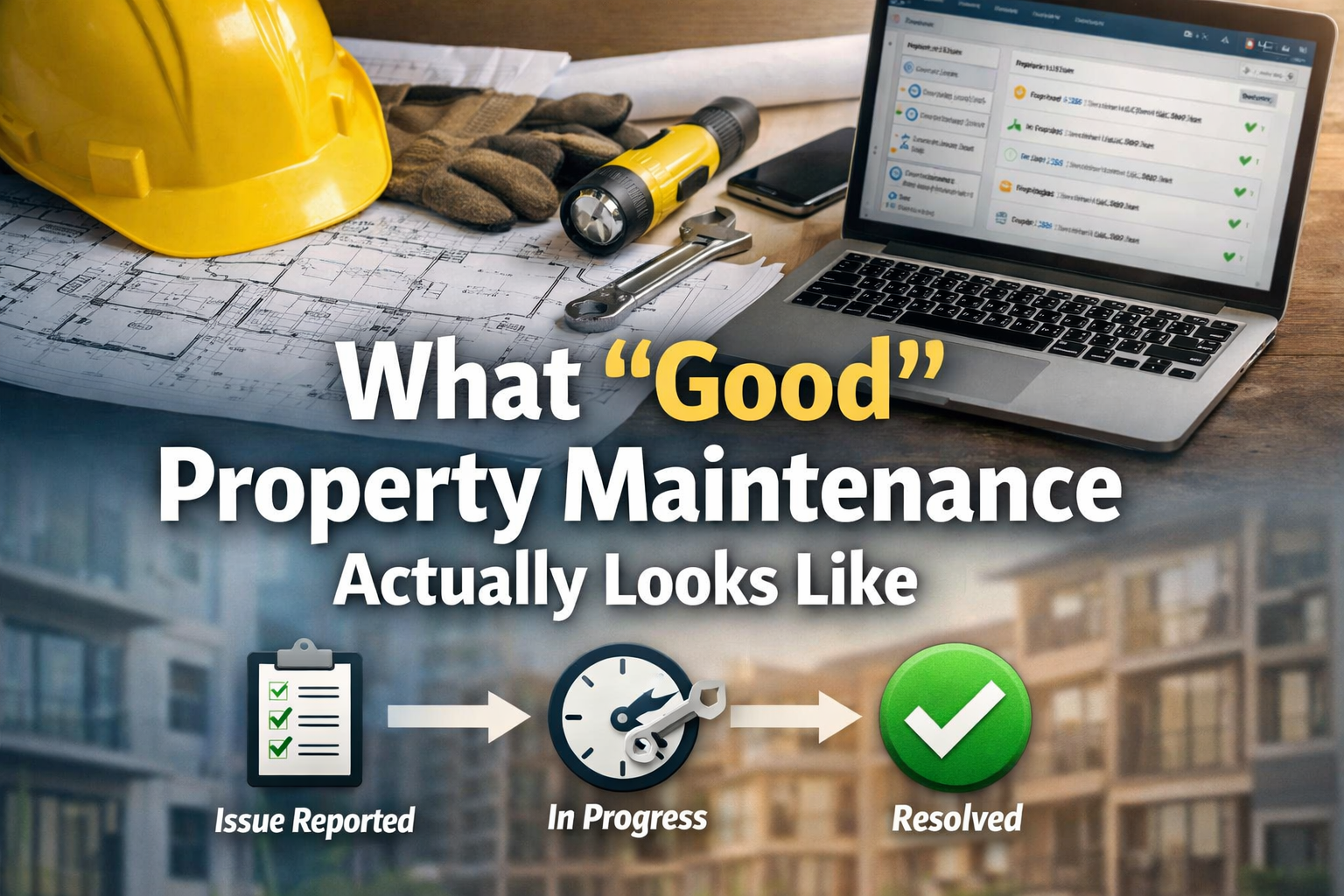
What “Good” Property Maintenance Actually Looks Like
What “Good” Property Maintenance Actually Looks Like
Everyone talks about improving maintenance processes.
Faster response times.
Better communication.
Stronger contractor relationships.
But very few actually define what “good” looks like in practice.
The Reality Behind Most Maintenance Processes
In many property management teams, the issue isn’t a lack of effort.
Teams are busy.
They’re responsive.
They’re doing their best to keep everything moving.
The problem is that information is often spread across multiple places:
Emails
Phone calls
WhatsApp messages
Notes in different systems
Conversations between team members
Individually, each interaction makes sense.
But over time, the full picture becomes fragmented.
Where the Real Pressure Shows Up
This usually isn’t obvious on a good day.
When everything is running smoothly, teams can rely on memory, experience, and informal communication to keep things moving.
But the real test comes when something is challenged.
A landlord asks for clarity.
A tenant raises a complaint.
A regulator requests evidence.
At that point, the question is no longer:
“Was this handled?”
It becomes:
“Can we clearly show what happened?”
What “Good” Actually Looks Like
In reality, a strong maintenance process is simple.
An issue is reported.
From that moment, everything related to that issue sits in one place:
The initial report
Every message
Every update
Every decision
Every action taken
All of it time-stamped.
All of it clearly linked.
At any point, anyone in the team can open that record and immediately understand:
What’s happened
What’s in progress
What’s been resolved
No digging through emails.
No chasing colleagues.
No piecing things together afterwards.
Just a clear, structured timeline.
Why This Matters More Than Ever
As expectations increase — around response times, compliance, and accountability —
this level of clarity is no longer a “nice to have.”
It’s becoming essential.
Because the difference between a strong operation and a reactive one is often this:
👉 One can demonstrate control
👉 The other has to reconstruct events after the fact
The Hidden Risk Most Teams Miss
Most teams don’t have a lack of information problem.
They have a lack of structure.
The data exists.
The actions have been taken.
But without a clear way of connecting everything over time, that information loses its value.
And when something goes wrong, the process shifts from managing the issue…
to trying to explain what happened.
The Real Test of a Process
A process isn’t defined by how it works on a good day.
It’s defined by how well it stands up when it’s challenged.
Because in property management, it’s not enough to do the right thing.
You also need to be able to demonstrate that you did.
If you’re reviewing your current processes, it’s worth asking a simple question:
If an issue from last month was challenged today, could your team clearly show what happened — without relying on memory?
Share this article
See Nestsen in action
Join property managers across the UK who have cut response times, reduced compliance risk and kept tenants happier with Nestsen.
Book a free demo →You might also like

The £0 Maintenance Issue That Turned Into a £20,000 Shock
26 March 2026
Why Property Maintenance Still Feels Like 1998 (And Why That’s About to Change)
22 March 2026

Integrating with Agency Software
20 March 2026
The Property Management System Most UK Letting Agents Use (And Why It’s Starting to Break)
12 March 2026