The Property Management Paradox: Why Doing More Work Can Make Landlords Feel Worse
TLDR
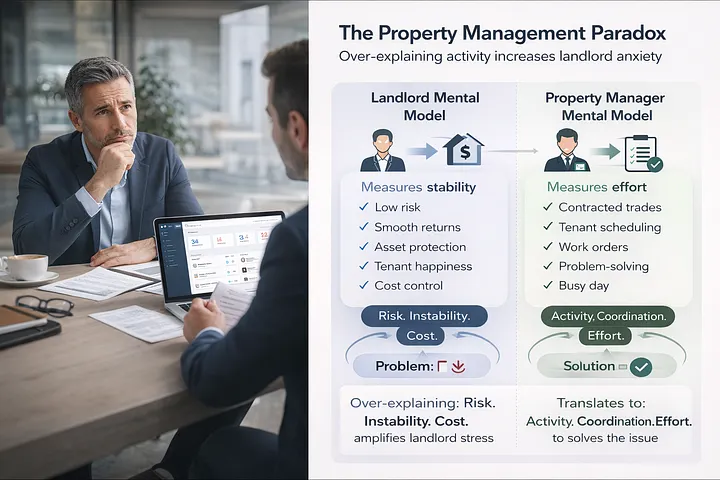
One of the strange paradoxes in property management is that the more operational detail a property manager shares, the more anxious a landlord can become. Property managers measure effort, coordination, and process. Landlords measure risk, stability, and asset value. Understanding this psychological gap is one of the most underrated skills in delivering great property management.
The Curious Case of the Perfectly Managed Problem
Imagine a boiler stops working in a rental property.
A diligent property manager springs into action.
They coordinate access with the tenant.
They schedule a contractor.
They arrange a second visit for parts.
They ensure everything is resolved.
From the manager’s perspective, this was handled efficiently and professionally.
They send the landlord an update explaining:
The tenant reported the issue Monday
A plumber attended Tuesday
Parts were required
The repair was completed Thursday
The landlord replies:
“Why did this take four days?”
The property manager is baffled. They worked hard. They coordinated everything. They solved the problem.
But the landlord has interpreted the update differently.
Instead of seeing competence, they see risk.
Effort vs Outcome
This is where the psychology of property management becomes interesting.
Property managers measure their work in effort and coordination. Landlords measure their investment in outcomes and stability.
When a manager explains the complexity of solving a problem, the landlord doesn’t hear professionalism. They hear uncertainty.
In other words:
The more detail you provide about a problem, the larger the problem can appear.
The Dentist Principle
Rory Sutherland often talks about how the best dentist doesn’t explain every step of the drill.
Imagine if your dentist said:
“First we’ll try this instrument, then we might need a second appointment, and there could be complications.”
You would panic. Instead, dentists simply say:
“We’ll take care of it.”
Property management has a similar communication paradox.
Managers often feel obliged to demonstrate effort.
Landlords simply want reassurance.
What Landlords Actually Want to Know
Landlords rarely wake up wondering:
How many contractors attended today
How many phone calls were made
How difficult scheduling was
What they really care about is surprisingly simple:
Is the tenant happy?
Is the property protected?
Are costs reasonable?
Is my investment stable?
The landlord’s mental model of a well-managed property is one where nothing dramatic is happening.
In other words, the ideal property manager is almost invisible.
Why This Matters More Than It Seems
This difference in perspective explains many common frustrations.
Property managers feel under-appreciated because they see the work involved.
Landlords feel uneasy because they see signs of instability.
Neither side is wrong. They’re just measuring success differently.
The most effective property managers understand this and translate operational activity into signals of confidence.
Instead of explaining every step of a repair, they communicate the outcome:
“The issue has been resolved and the property remains in excellent condition.”
The Hidden Skill in Property Management
This ability to translate operational chaos into calm reassurance is an underrated professional skill.
Great property managers are not just coordinators. They are interpreters of complexity. They take a messy, unpredictable environment and present it in a way that gives landlords confidence their investment is safe.
Where Technology Quietly Helps
Modern property management platforms make this easier.
They capture operational detail while presenting landlords with the information that actually matters:
Response times
Resolution rates
Property condition
Maintenance history
Cost visibility
This allows property managers to manage the detail without overwhelming landlords with it.
Done well, technology doesn’t just make operations more efficient.
It helps property managers communicate confidence.
Key Takeaways
Property managers measure effort and coordination.
Landlords measure stability and risk.
Sharing too much operational detail can unintentionally increase landlord anxiety.
Great property managers translate complexity into reassurance.
Clear communication improves trust and long-term relationships.
Share this article
See Nestsen in action
Join property managers across the UK who have cut response times, reduced compliance risk and kept tenants happier with Nestsen.
Book a free demo →