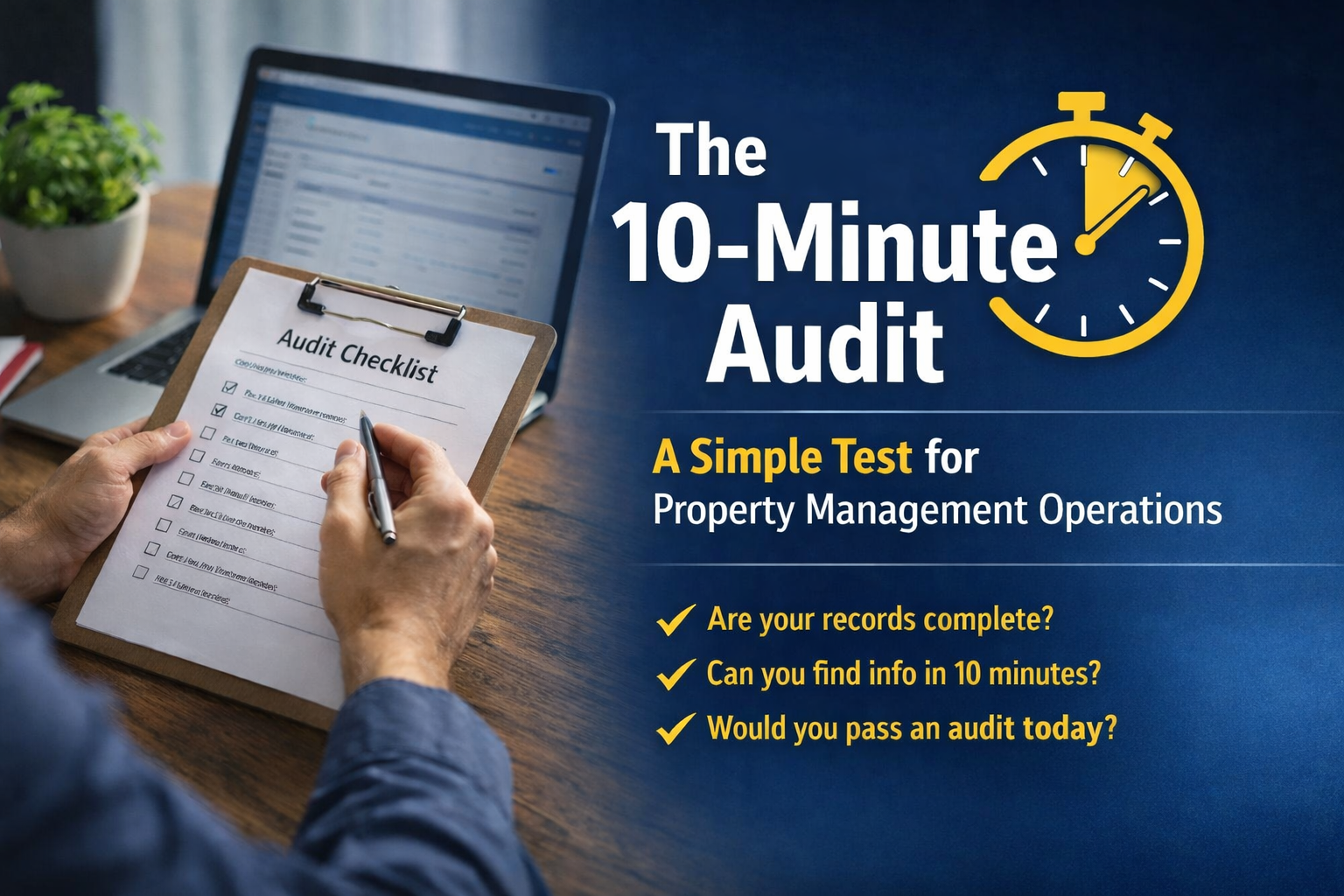
The 10-Minute Audit: A Simple Test for Property Management Operations
The 10-Minute Audit: A Simple Test for Property Management Operations
Most letting agencies don’t realise how reactive their operations are until they run a simple test.
If an audit landed tomorrow, could your team evidence every maintenance action, update and compliance check within 10 minutes?
Not eventually.
Not after digging through inboxes.
Not after asking colleagues to piece it together.
Ten minutes.
For many property managers, that simple exercise reveals more about operational structure than any internal review.
Why Operational Pressure Is Increasing in the Lettings Sector
Across the lettings sector, operational expectations are rising quickly.
Regulation is tightening.
Documentation requirements are expanding.
Tenants expect faster responses and clearer communication.
Several developments are accelerating this shift:
The Renters’ Rights Act
Expanding expectations under Awaab’s Law
Increased scrutiny around compliance documentation
Tenants expecting real-time updates and transparency
At the same time, property managers are often responsible for growing portfolios while juggling contractors, landlords, tenants and compliance deadlines.
Despite these pressures, many agencies still rely heavily on manual operational workflows.
Where Operational Risk Actually Appears
In many property management operations, day-to-day work still relies on:
Inbox chasing
Manual reminders
Fragmented notes across systems
Verbal updates between team members
Most of the time, these systems appear to work.
Until they don’t.
The real issue usually isn’t workload.
It’s visibility.
The missed follow-up.
The undocumented phone call.
The contractor update that never made it into the system.
Reactive management doesn’t fail because teams aren’t working hard.
It fails because structure hasn’t kept pace with regulation and operational complexity.
How to Run the 10-Minute Audit
The 10-minute audit is a simple operational test.
Pick a recent maintenance issue or compliance event and ask your team to produce the full record of activity.
Within ten minutes, you should be able to show:
When the issue was reported
Who acknowledged it
What action was taken
When contractors were contacted
What updates were shared with the tenant or landlord
The final outcome or resolution
If that information can be presented clearly and quickly, your operational visibility is likely strong.
If the process involves searching through emails, asking colleagues for context or piecing together timelines manually, the system may be more reactive than it appears.
The Difference Between Reactive and Structured Operations
The agencies pulling ahead today aren’t necessarily less busy.
They’re simply more structured.
They can clearly see:
What work is outstanding
What has escalated
What has been documented
What would stand up under external scrutiny
That visibility changes everything.
Teams spend less time searching for information.
Communication becomes clearer.
Response times improve.
Stress levels across teams reduce.
Instead of firefighting problems, teams can focus on resolving them.
Why Visibility Changes Property Management
In property management, operational risk rarely appears as one dramatic event.
Instead, it accumulates quietly.
A missed follow-up here.
A delayed contractor update there.
A compliance reminder that slips through the cracks.
Individually these issues seem minor.
But over time they compound.
Visibility is what prevents these small operational gaps from turning into larger problems.
When workflows are structured and communication is captured automatically, the audit trail takes care of itself.
Why the 10-Minute Audit Matters
Most operational risk in property management isn’t dramatic.
It’s quiet.
It’s the thing you didn’t realise you missed.
And as regulation across the private rented sector continues to tighten, those small operational gaps are becoming increasingly expensive.
Running the 10-minute audit is a simple way for agencies to test whether their operational structure supports the level of visibility, documentation and accountability the sector now expects.
Final Thought
The question isn’t whether your team is working hard.
Most property management teams already are.
The real question is whether the structure behind the work allows you to evidence it clearly, quickly and confidently when it matters.
Because in today’s regulatory environment, that difference is becoming critical.
Share this article
See Nestsen in action
Join property managers across the UK who have cut response times, reduced compliance risk and kept tenants happier with Nestsen.
Book a free demo →